
Helios b
Jovian gas giant
A banded giant with no surface to stand on — only a thousand kilometres of layered sky. Sunlight dies long before the depths, so life clings to a single temperate shelf of ammonia cloud near 0.7 atmospheres, where the cold is survivable and the light still feeds. Here the Cloudwhale floats out its century on heat alone. Fall too far and the pressure crushes you: a world you survive only by never coming down.
Life on Helios b · 4 species

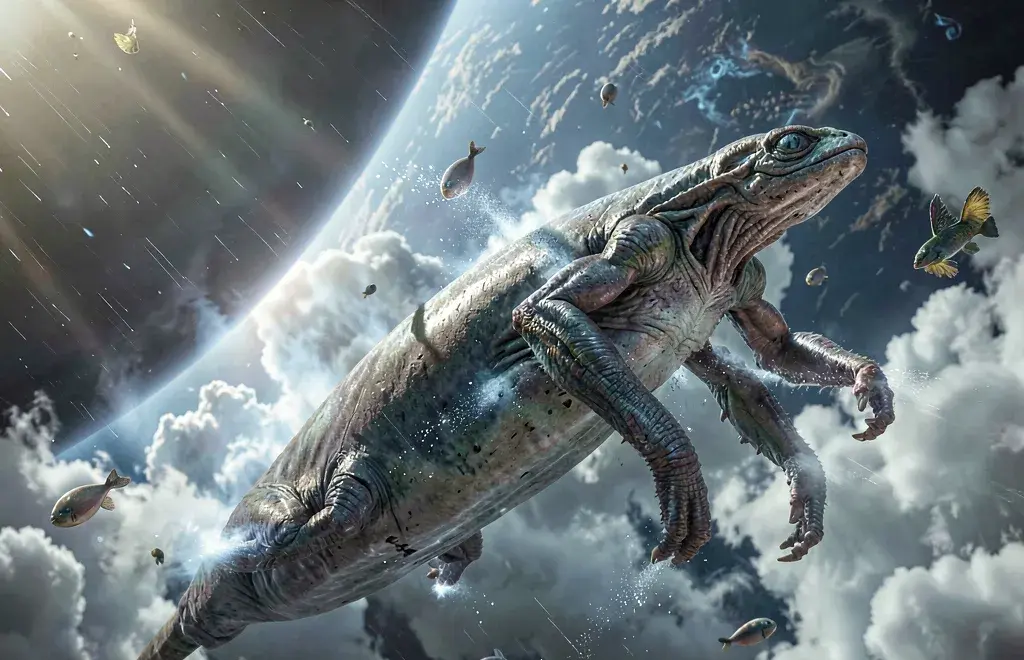
Vaporis venator, colloquially the Void-Pouncer, dominates the mid-troposphere of Helios b as a specialized micro-predator adapted to crushing gravitational forces. This streamlined ambush hunter propels itself through dense ammonia currents using rapid, pressurized gas bursts, allowing sudden accelerations to snatch smaller filter-feeders from the swirling cloud layers. Its obsidian carapace resists extreme pressure while its six thickened limbs function as living grappling hooks. When energy conservation is critical against the relentless downward force, the creature latches onto migrating Cloudwhales. These massive filter-feeders provide stable perches, shielding the tiny hunter from turbulent shear winds. From this secure anchor, the Void-Pouncer waits motionless, conserving metabolic resources until the next drift of prey-rich fog passes within striking range.
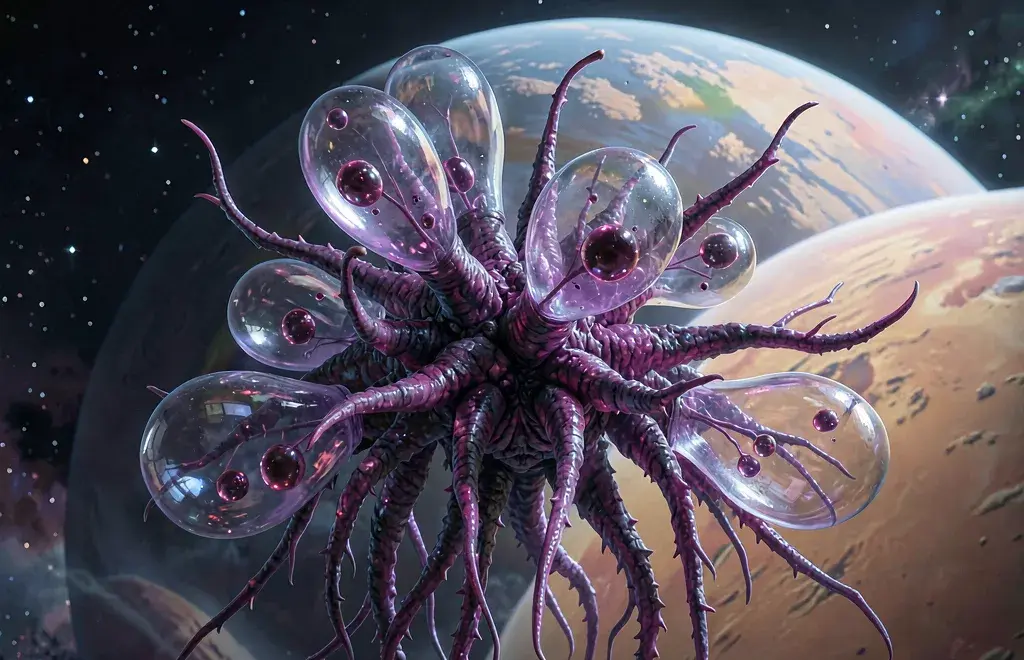
Drifting within Helios b's 0.7 atm thermal layer, *Nitroalga suspensa* manifests as vast, translucent mats of floating bladders filled with low-melting hydrocarbons. These transparent vessels provide buoyancy and insulation against the Jovian depths, allowing the organism to remain suspended in the narrow habitable zone where temperatures permit slow metabolic activity. The delicate structures shimmer faintly, barely visible through the dense ammonia haze that shrouds the gas giant's atmosphere. Beneath their clear surfaces, violet pigments harvest the scarce infrared radiation penetrating the upper cloud decks. This specialized phototrophy fuels a sluggish, deep-energy photosynthesis adapted to the dim, long-wavelength light environment. As primary producers in this alien ecosystem, these glass-like weeds form the foundational biomass, slowly converting faint stellar warmth into organic matter for the unseen drifters of Helios b's endless skies.
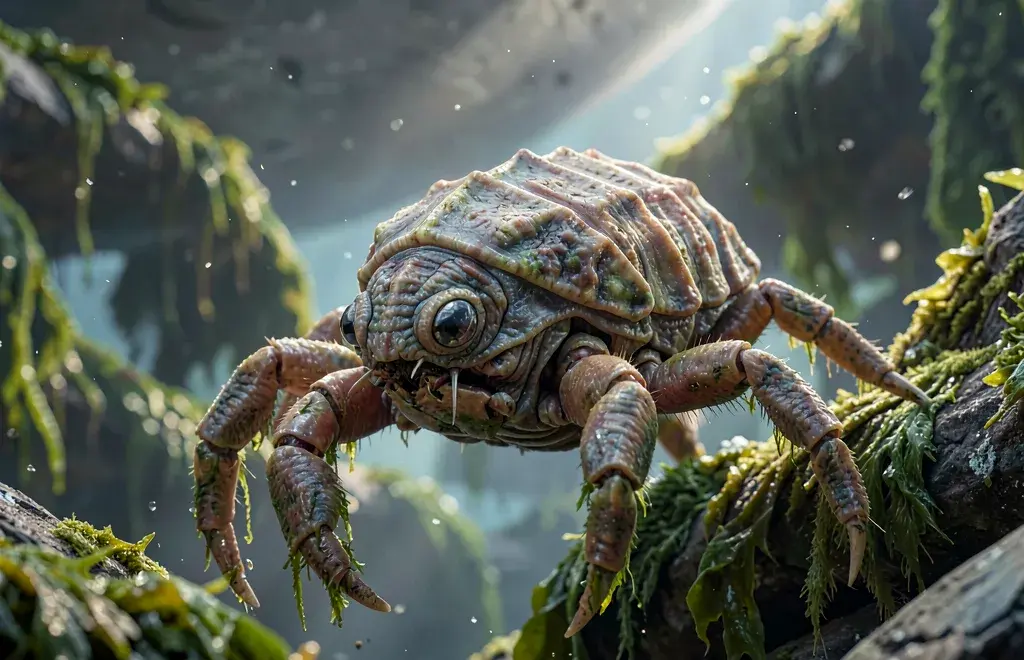
The Gravity-Drifter (*Gravicus carapax*) thrives within Helios b's crushing lower troposphere, where its chitinous ridges are uniquely reinforced to withstand 2.4 Gs of pressure. Resembling a massive, slow-moving crab, this filter-feeder navigates turbulent shear zones by constantly exchanging internal hydrogen for external helium, maintaining perfect neutral buoyancy amidst the swirling storms. Using specialized mandibles, it scrapes nutrient-rich biofilm from the undersides of drifting algae mats that float in the planet's amber haze. Despite its heavy armor, the creature moves with surprising grace, grazing microbial communities while avoiding the deadly winds that shred lesser life forms in this high-gravity, buoyant ecosystem.
World Data
- Star
- Helios · G-type yellow
- Gravity
- 2.4 g
- Atmosphere
- H₂–He, ammonia clouds
- Surface
- none — endless sky