
Aethelgard
Subsurface Biosphere (Supercritical Hydrothermal Karst)
Life on Aethelgard · 4 species

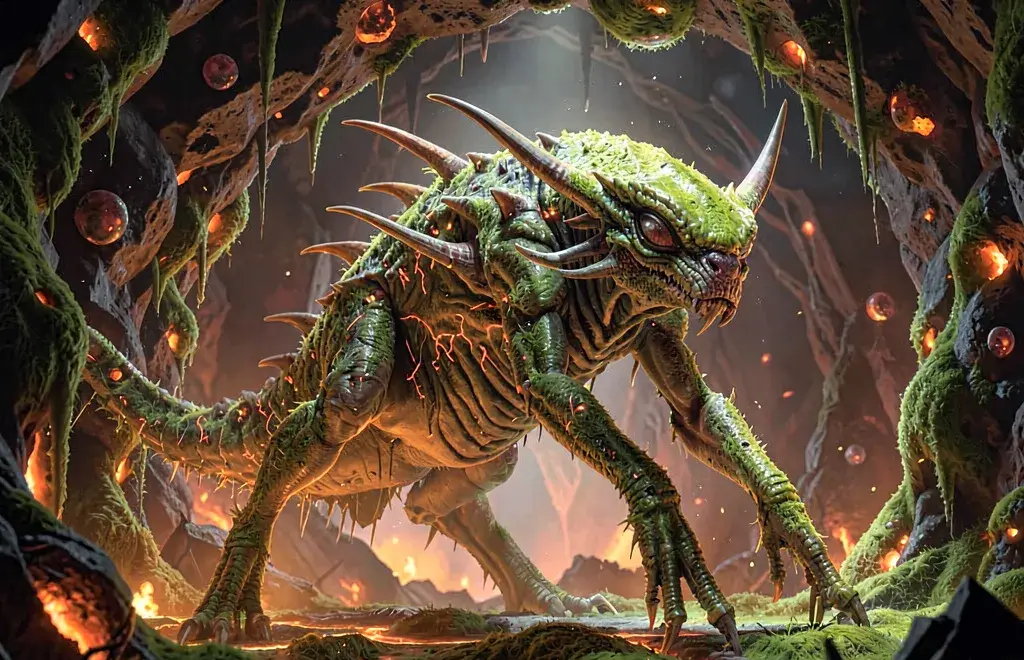
Silicofila thermis manifests as a faint, iridescent patina clinging to the supercritical karst walls of Aethelgard's deep fissures. This microscopic biofilm thrives within intense thermal gradients, harvesting geothermal radiation and chemical potential through specialized silicate lattices that resist extreme pressure. Its growth forms delicate, heat-radiating ripples across basalt surfaces, glowing with a subterranean amber hue where fluid flow is strongest. As the foundation of this subsurface food web, Thermal-Moss supports vast colonies of filter-feeding crustaceans that graze directly upon its resilient matrix. These grazers process the biofilm's heat-stable lipids, converting geothermal energy into biomass for higher trophic levels. Without this silent, glowing carpet, the dark karst ecosystems would lack the primary production necessary to sustain their unique, pressure-adapted fauna.
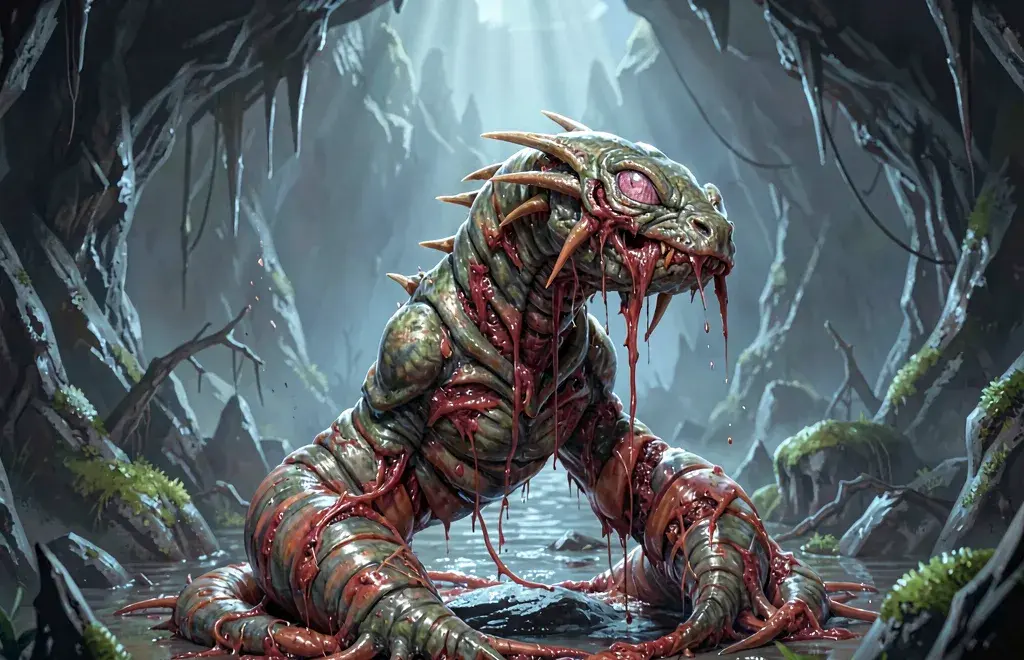
The Vent-Scavenger (*Thermovora minor*) is a diminutive, segmented vermiform inhabiting Aethelgard's supercritical hydrothermal karst. Its translucent carapace withstands extreme thermal gradients, allowing it to navigate narrow fissures where Stratum-Weavers perish. This detritivore anchors itself within decaying silicate matrices, utilizing specialized mandibles to mechanically fracture organic-silica bonds that would otherwise persist for millennia in the high-pressure environment. Rapid enzymatic secretion dissifies complex polymers into absorbable nutrients, facilitating efficient recycling of biomass back into the subsurface nutrient cycle. By converting fallen Weaver tissue into soluble slurry within hours, *T. minor* prevents toxic accumulation of silica-rich detritus. Its rhythmic pulsations through dark fissures sustain the delicate chemical equilibrium essential for this isolated biosphere's continued existence.

The Pressure-Weaver (*Nebula arachnea*) inhabits Aethelgard's supercritical hydrothermal karst, appearing as a semi-transparent, gas-filled sac drifting along the Stratum-Weaver's lower boundary. Its delicate, buoyant form allows silent navigation through dense mineral mist, where it injects potent neurotoxins via hollow filaments to stun prey before extracting nutrient-rich fluids. Functioning as both predator and population regulator, this entity maintains ecosystem balance by culling overabundant subsurface fauna. Its internal pressure sensors detect seismic shifts in the karst network, enabling precise ambushes. Despite its fragile appearance, the Weavers possess remarkable resilience, thriving where extreme heat and crushing pressure would crush terrestrial life forms.
World Data
- star
- None (Stellar insolation blocked by 40km silicate crust; surface is frozen void)
- gravity
- 0.82 G
- atmosphere
- Supercritical Water Veins (420°C, 250 atm), rich in dissolved H2S, SiO2, and metals
- temp
- Constant 420°C at depth; thermal gradients drive convection