
Palesia
Litho-Vacuum
Life on Palesia · 4 species


Radiolith forms vast, luminescent mats across Palesia's fractured crust, harvesting decay energy directly from unstable isotopes within the litho-vacuum. These silica-based fungal colonies metabolize radiation into glucose-like polymers, creating a bioluminescent glow that pulses in rhythmic bursts as they process uranium-rich substrates. Their porous, rock-hard mycelium anchors deep into bedrock, extracting trace minerals while neutralizing lethal gamma fluxes through unique crystalline filtration. Serving as the planet's sole primary producers, Radiolith mats sustain the entire void-weaver ecosystem by converting sterile stone into edible biomass. The weavers graze on these glowing patches, ingesting concentrated nutrients that allow them to survive Palesia's harsh atmosphere. Without this radioactive symbiosis, the fragile biosphere would collapse into total desolation beneath the silent, star-filled sky.

The Vacuum Skimmer (*Aerovaga voidis*) hovers silently above Palesia's fractured crust, sustained by powerful static-electricity fields generated between its chitinous wings. This litho-vacuum predator drifts effortlessly through the thin atmosphere, its translucent carapace absorbing ambient radiation to charge its levitation mechanism, allowing it to linger motionless for hours while scanning for heat blooms below. Its primary hunting strategy relies on acute thermal sensitivity rather than visual acuity. The Skimmer locks onto the faint, rhythmic warmth emitted by subterranean Void-Weavers as they migrate through rock fissures. Upon detection, it drops in a controlled silence, using electrostatic grips to snatch its prey before vanishing back into the high-altitude static currents, leaving no trace save for a sudden drop in local electrical potential.
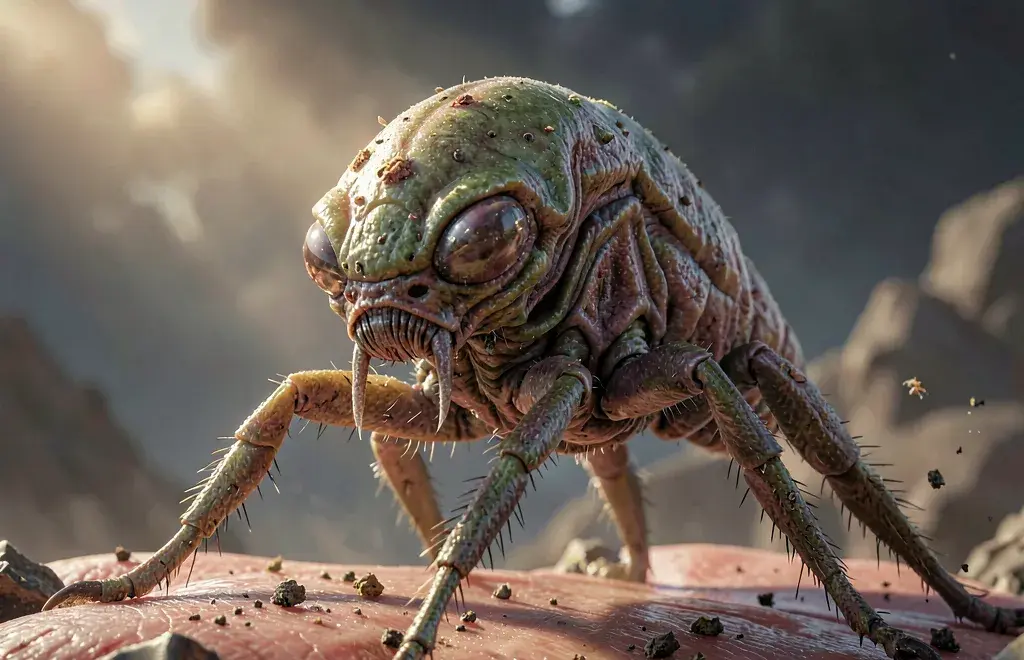
Regolithus minutus thrives within Palesia’s brittle Litho-Vacuum atmosphere. Resembling translucent arachnids barely visible to the eye, they possess chitinous exoskeletons adapted to filter fine regolith from exposed surfaces. They navigate static fields with delicate appendages, seeking particulate matter suspended in thin air or clinging to fauna. Functioning as detritivores, they consume oxidized mineral dust and organic debris, cleaning host skin. Their digestive enzymes break down silicate grains into harmless waste. Without *R. minutus*, Palesian ecosystems would succumb to abrasive accumulation; thus, they are cultivated as living polishers in prime zones.
World Data
- star
- Interstellar Rogue
- gravity
- 0.3 G
- atmosphere
- Trace Argon/CO2 (<0.1 kPa)
- temp
- -10C to +30C (Tidal)