
Magneto-9
Magnetar-Shielded World
Life on Magneto-9 · 4 species


Siphonum corrosa forms dense, gelatinous mats clinging to the basaltic cliffs of Magneto-9, thriving where stellar winds strip conventional life. These filamentous networks secrete a hyper-viscous mucilage that neutralizes the planet's pervasive sulfuric mists, creating a localized pH buffer essential for photosynthesis within the churning atmospheric vortex. Beneath this protective crust lies the true marvel: a lattice of bio-magnetic filaments that harness the world's intense magnetosphere to drive chemosynthetic reactions. By converting magnetic flux directly into chemical energy, these primary producers sustain entire ecosystems while shielding their fragile core from corrosive erosion, turning lethal radiation into sustenance.

Chthonos profundus, the Magma-Lurker, thrives in the crushing darkness of Magneto-9's subglacial oceans, anchored by intense magnetic fields that strip away surface radiation. This elongated, armored predator patrols thermal vents, its heat-sensing dermal plates detecting minute fluctuations in water temperature. Its silhouette remains nearly invisible against the black rock until it strikes with a sudden, jet-propelled lunge, jaws lined with magnetized crystals designed to pierce the tough exoskeletons of prey. Its primary diet consists of Flux-Weavers that drift down from the upper currents, drawn inevitably toward the vent's warmth before succumbing to pressure or exhaustion. The Lurker consumes these nutrient-rich carcasses with ravenous efficiency, utilizing stored thermal energy to sustain its metabolism during long periods of scarcity. Bioluminescent lures mimic dying plankton, tricking other scavengers into range before the Magma-Lurker asserts its dominance as the vent's apex hunter.
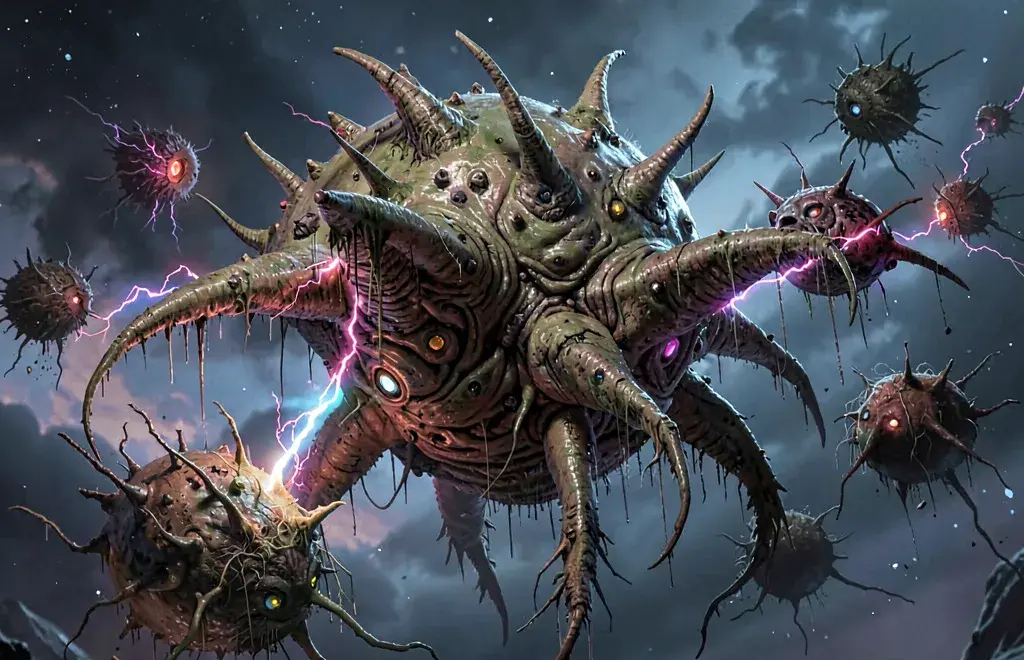
Globulus magnus, or Spore-Drifter, is a translucent microfauna endemic to Magneto-9's charged upper atmosphere. These gelatinous spheres ride intense magnetic currents, their internal organelles acting as bio-electric conductors that stabilize them against the planet's violent stellar winds. Lacking fixed limbs, they drift in shimmering swarms, guided by electromagnetic gradients rather than sight or sound. Functioning as crucial decomposers, Spore-Drifters consume suspended organic particulates and dead matter, efficiently recycling nutrients back into the magnetosphere ecosystem. Their semi-permeable membranes filter debris while excreting vital minerals that nourish lower-altitude flora. Without these silent recyclers, Magneto-9's nutrient cycle would collapse, leaving its shielded biosphere to starve amidst endless stellar radiation.
World Data
- star
- Magnetar PSR J1846-0258
- gravity
- 1.5g
- atmosphere
- Sulfuric/CO2 Mist
- temp
- -20°C