
Borealis Prime
High-Gravity Super-Earth (2.8g)
Life on Borealis Prime · 4 species


Nebula volatus, the Aether-Jelly, is a translucent, balloon-like drifter perfectly adapted to Borealis Prime's crushing 2.8g gravity and dense atmosphere. Its gelatinous body maintains neutral buoyancy within the thick air layers, allowing it to float passively while its internal symbionts harvest dim red dwarf photons for photosynthesis. This efficient primary producer forms vast, shimmering clouds that drift with high-altitude currents, converting stellar energy into biomass despite the planet's low light intensity. Despite their fragile appearance, these organisms possess reinforced collagen lattices to withstand atmospheric shear stress. They serve as the critical dietary foundation for the region's apex grazer, the Hexa-Strider. Predators detect these drifting herds via thermal signatures and consume them in vast quantities, sustaining the super-earth's unique high-gravity food web while ensuring the Aether-Jelly's rapid reproductive cycle keeps pace with predation pressure.
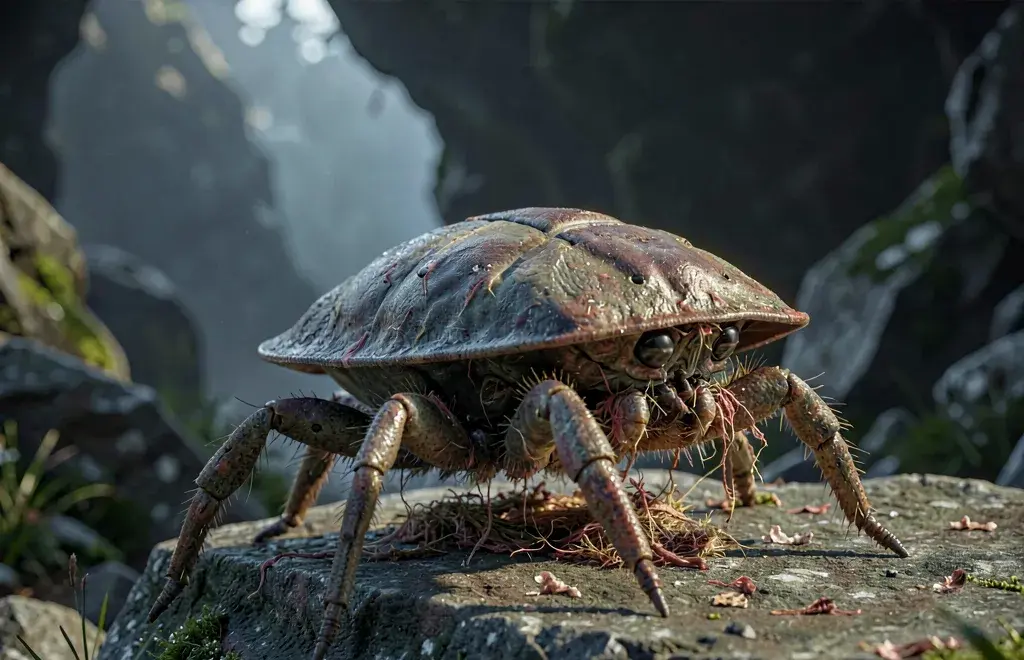
The Crush-Crab (*Lithosoma clippers*) thrives under Borealis Prime's crushing 2.8g gravity, its flattened, slate-grey carapace hugging the bedrock to minimize drag and structural stress. Six robust, piston-like legs anchor the creature firmly against the pull, allowing it to scuttle with surprising agility across jagged outcrops where larger fauna cannot tread. Specialized mandibles function as hydraulic shears, effortlessly slicing through the tough exoskeletons of deceased Striders. As a primary decomposer, this low-profile scavenger rapidly recycles organic matter into the nutrient-poor soil, its efficient metabolism turning death into sustenance before the high gravity can fully compact the remains.

Thermoflora densa, colloquially known as Vent-Moss, anchors itself to tectonic fissures on Borealis Prime, thriving under crushing 2.8g gravity. Its thick, leathery fronds form dense, rust-colored mats that insulate against ambient cold while channeling geothermal heat inward. Through chemosynthesis, the moss converts sulfur-rich vent emissions into complex sugars, creating a localized thermal oasis vital for survival in this high-pressure environment. This micro-habitat serves exclusively as a nursery for Hexa-Striders, whose calcified eggs require the moss's consistent warmth and nutrient seepage to hatch. The plant's porous structure buffers the larvae from atmospheric turbulence, while its metabolic byproducts provide essential amino acids during early development. Without these resilient biological foundations, the planet's dominant arthropod fauna would lack a viable reproductive strategy in such extreme conditions.
World Data
- star
- M4 Red Dwarf
- gravity
- 2.8g
- atmosphere
- Dense Nitrogen-Methane, high partial pressure
- temp
- -60°C to -10°C (Thermal vents provide local warmth)