
Xylos-Prime
Hyper-arid Super-Desert
Life on Xylos-Prime · 4 species

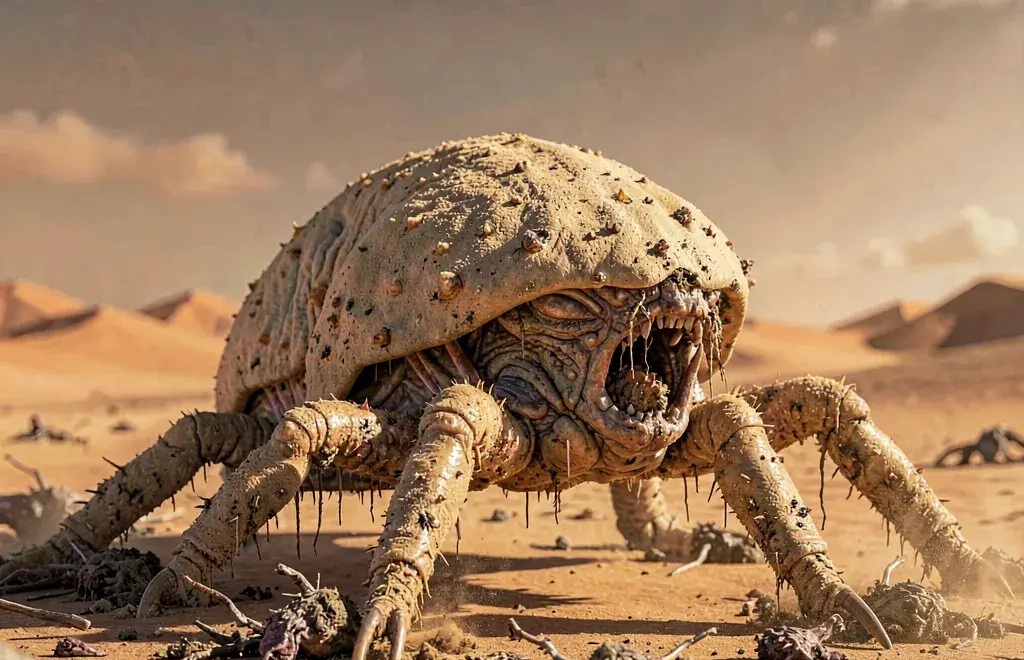
The Dust-Strider (*Arenavolva cursor*) navigates Xylos-Prime's hyper-arid dunes with a low, fluid gait, its six sand-colored legs skimming just above the abrasive surface. Its carapace, thick and matte-textured like weathered flint, resists wind-borne grit while reflecting the harsh solar glare. This scavenger moves silently through the dead zones, driven by chemoreceptors that detect faint traces of desiccated organic matter buried beneath the shifting sands. Feeding primarily on dust-clogged debris and the rare remains of crashed landers or native flora, the creature utilizes a specialized mandible array to grind compacted detritus into digestible slurry. It rarely pauses, constantly cycling through micro-habitats to avoid thermal stagnation. In this unforgiving desert, the Dust-Strider serves as a vital biological filter, turning Xylos-Prime's perpetual dust storms into nutrients for the sparse ecosystem below.
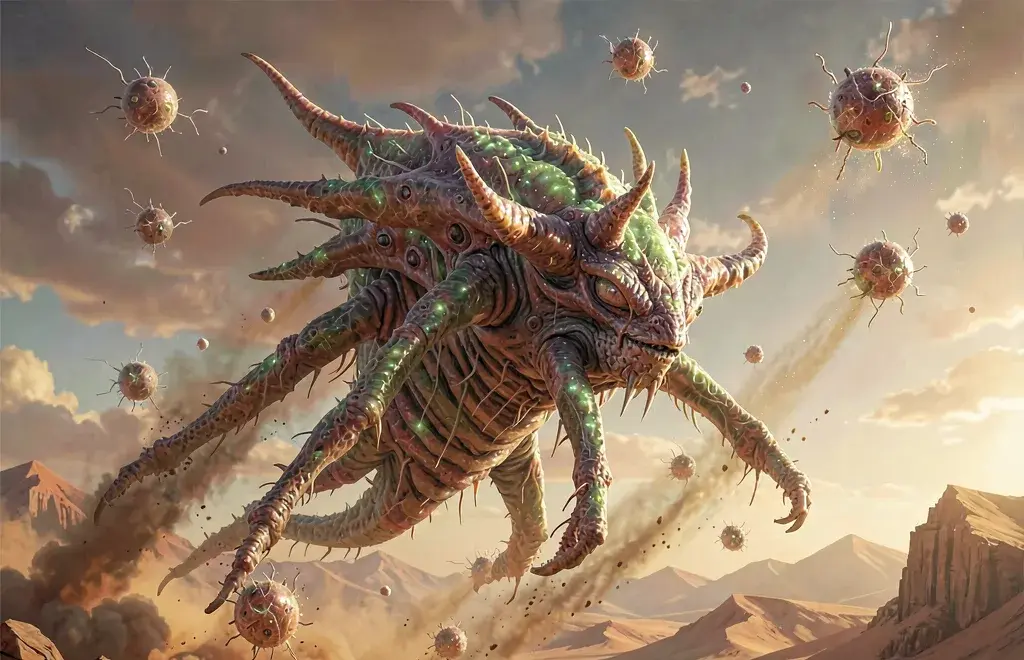
The Storm-Weaver (*Nebula filamentus*) manifests not as a single organism but as a shimmering, gossamer cloud of microscopic cells drifting in Xylos-Prime's jet stream. Suspended kilometers above the hyper-arid dunes, this colonial entity captures suspended dust and rare atmospheric ions, its translucent filaments acting as living sieves against the relentless solar winds that scour the planet's surface. Despite the scorching heat below, these high-altitude scavengers thrive in the thin, cold upper currents. They reproduce by fragmenting into smaller drifts during seasonal electrification events, seeding new colonies downwind. To the ground observer, they appear only as fleeting, iridescent veils that briefly color the violet sky before vanishing back into the vast, nutrient-poor emptiness of the desert atmosphere.
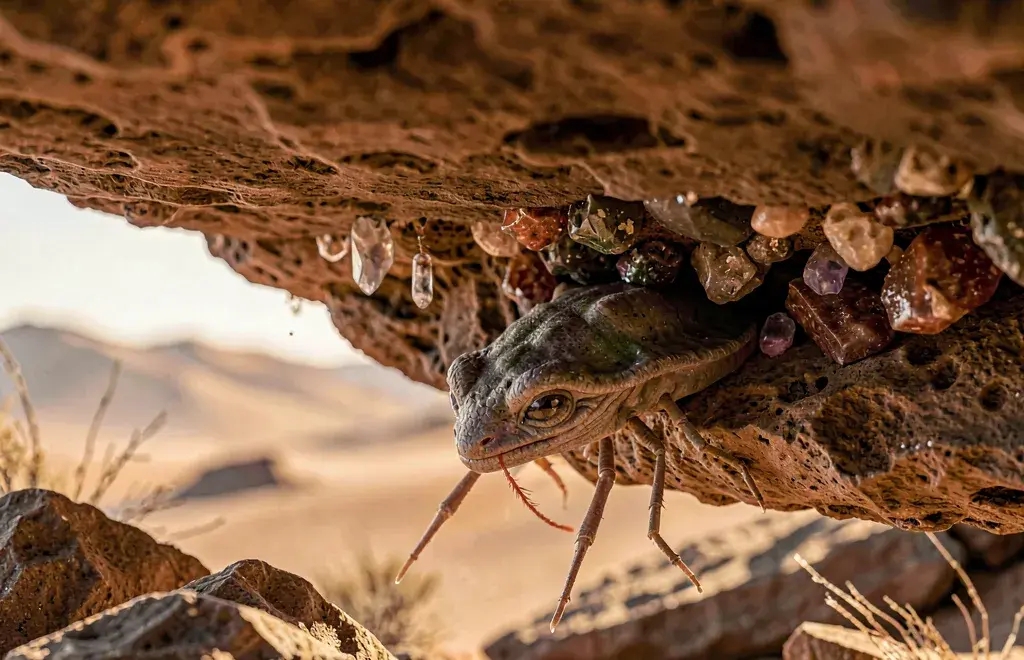
Petromyzon saxum, or the Rock-Leech, is a diminutive, dorsoventrally flattened vermiform endemic to Xylos-Prime's hyper-arid dunes. It clings exclusively to the calcified ventral surface of the Gale-Twin's massive Anchor roots, secreting acidic enzymes to extract excess silica and trace metals from the plant's sap. In return for this mineral harvest, the leech forms a defensive symbiosis; its tough, chitinous integument shields the host root from invasive burrowing pests like sand-skimmers. This mutualistic arrangement allows both species to thrive in an environment where resources are scarce and predation on subterranean structures is constant.
World Data
- star
- K-type Orange Dwarf (dim, red-shifted)
- gravity
- 0.85g (Earth)
- atmosphere
- Thin CO2/N2 with high particulate loading; 0.4 atm surface pressure
- temp
- -40°C to 15°C (extreme diurnal swing)