
Boreas Prime
Class IV Super-Jovian
Life on Boreas Prime · 4 species


Drift-Spore (*Aerospore vitreus*) manifests as a shimmering cloud of microscopic, silica-based cells suspended in Boreas Prime's upper atmosphere. These translucent organisms harvest piezoelectric charge directly from the planet's violent wind shears, converting kinetic turbulence into metabolic energy. Their glass-like structures refract the dim starlight into faint, internal glows, creating a bioluminescent haze that blankets the gas giant's jet streams. As the primary producers of this aerial ecosystem, Drift-Spores form the foundational biomass for all higher life on the Super-Jovian world. Larger filter-feeders migrate vertically to graze these dense spore fields, while the Spores themselves reproduce asexually when electrical charges peak during storm fronts, perpetuating a cycle entirely dependent on atmospheric friction and gale-force winds.
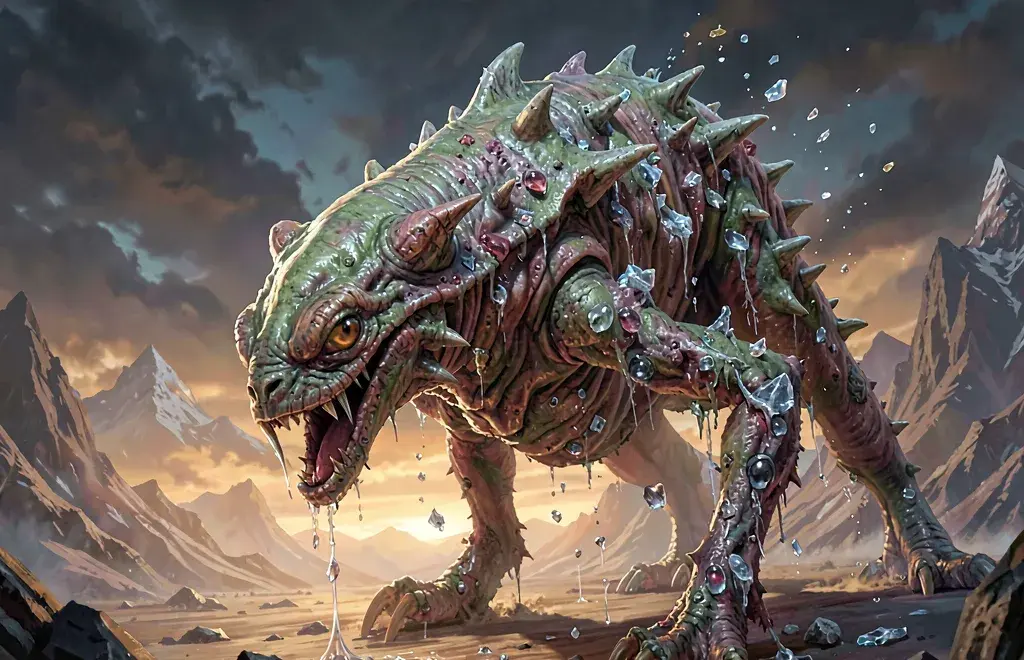
Necrocarapax abyssus, or the Pressure-Scavenger, inhabits Boreas Prime's crushing upper atmosphere as a minute, brittle entity. Resembling translucent shards of glass barely three centimeters long, these organisms cluster in silent flocks upon the drifting armor-scales shed by the colossal Magma-Weavers. Specialized enzymes allow them to rapidly dissolve the silicate-rich carapaces into basic particulates. By breaking down this fallen debris, they efficiently return vital minerals to the planetary cycle, acting as the super-gas giant's essential detritivores that transform dead armor back into the raw materials for new geological life.
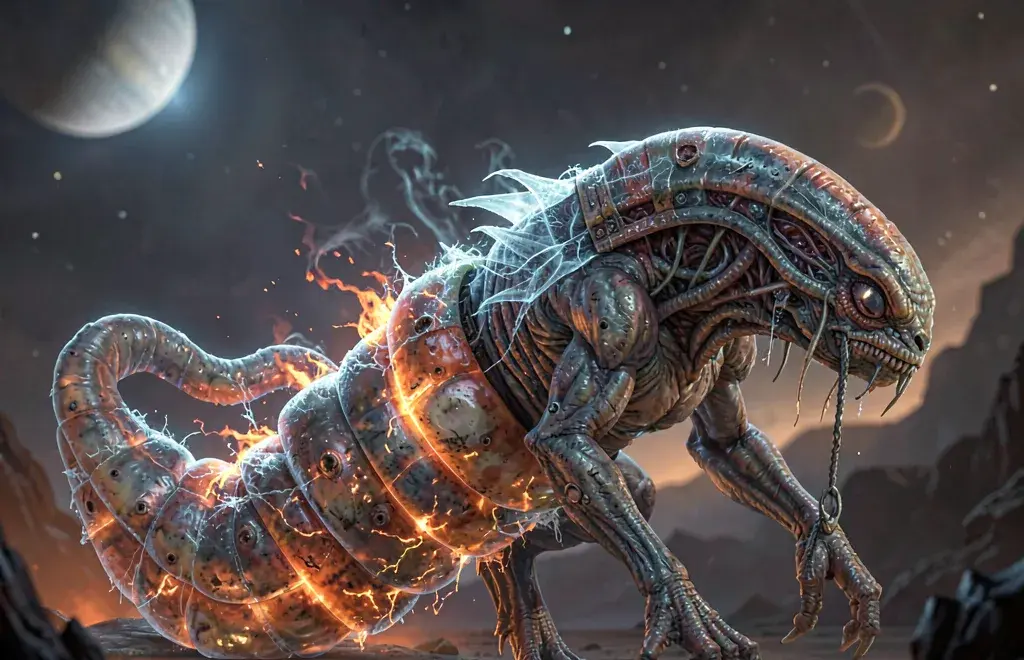
Umbra caloris manifests as a ghostly, translucent leech drifting through Boreas Prime's super-heated upper atmosphere. It seeks out the massive Magma-Weaver, a colossal atmospheric predator, and latches onto its external thermal bladders. Using specialized siphons, it draws away excess metabolic heat with chilling efficiency, rendering the host lethargic while the parasite sustains itself on thermal energy. Over days, this parasitic drain induces rapid hypothermia in the Magma-Weaver, causing its internal magma core to solidify and freezing its limbs into brittle ice. As the host succumbs, Umbra caloris detaches, leaving behind a frozen carcass that serves as both a warning and a final nutrient source before drifting onward to seek new thermal victims.
World Data
- star
- M-dwarf (Red Dwarf, 0.08 Solar Mass)
- gravity
- 45 m/s² (4.6g)
- atmosphere
- Dense Ammonia-Methane slurry with suspended silane aerosols; no free oxygen, high partial pressure of hydrogen and helium.
- temp
- -150°C (Upper Stratosphere) to +250°C (Deep-Convective Layer)