
Ares-Prime
Iron-Oxide Super-Earth
Life on Ares-Prime · 4 species

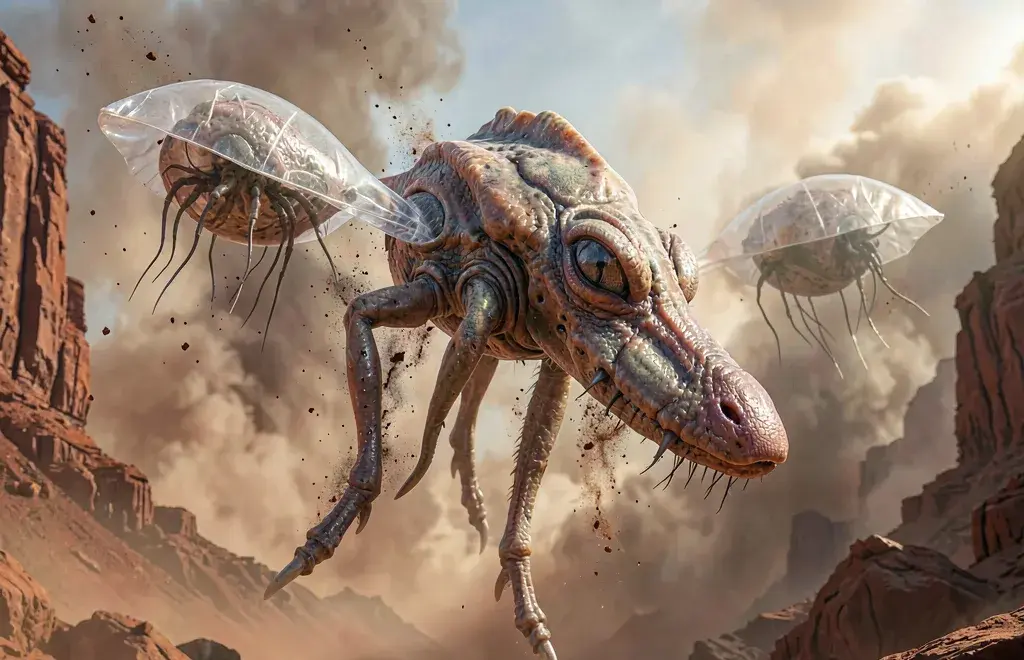
Found within the rust-colored upper haze of Ares-Prime, *Aerospira volans* are semi-translucent, gas-bag organisms that drift silently through dense atmospheric layers. Their gelatinous bodies expand to maintain buoyancy against the planet's crushing gravity, utilizing lightweight internal vacuoles filled with lighter-than-air isotopes harvested from volcanic vents. These graceful grazers float in vast, shimmering schools, their delicate membranes undulating gently as they navigate turbulent jet streams. Functionally acting as atmospheric filter feeders, *Aerospira* extend microscopic cilia to sieve iron-oxide dust and organic aerosols directly from the air. They digest these particulates via internal enzymatic sacs, converting the mineral-rich intake into metabolic energy while expelling purified gas back into the cycle. This unique adaptation allows them to thrive where surface life cannot, turning the planet's choking smog into a vast, floating food web.

Ochromus minutus, the Micro-Scavenger, thrives in the rust-dust canyons of Ares-Prime as a specialized detritivore. These microscopic organisms swarm the massive Iron-Skin Crawler, rapidly colonizing its shed exoskeletal plates and metabolic waste. Their metallic-hued carapaces absorb ambient gamma radiation, converting it into energy to fuel rapid enzymatic breakdown of complex organics into simple iron-rich nitrates. In this harsh super-Earth ecosystem, Ochromus acts as a vital recycling engine, preventing toxic organic accumulation beneath the Crawler's migratory paths. Observations reveal swarms shifting color from dull ochre to vibrant crimson when digestion peaks, marking them as both decomposers and biological indicators of the planet's fragile, iron-dominated nutrient cycle.
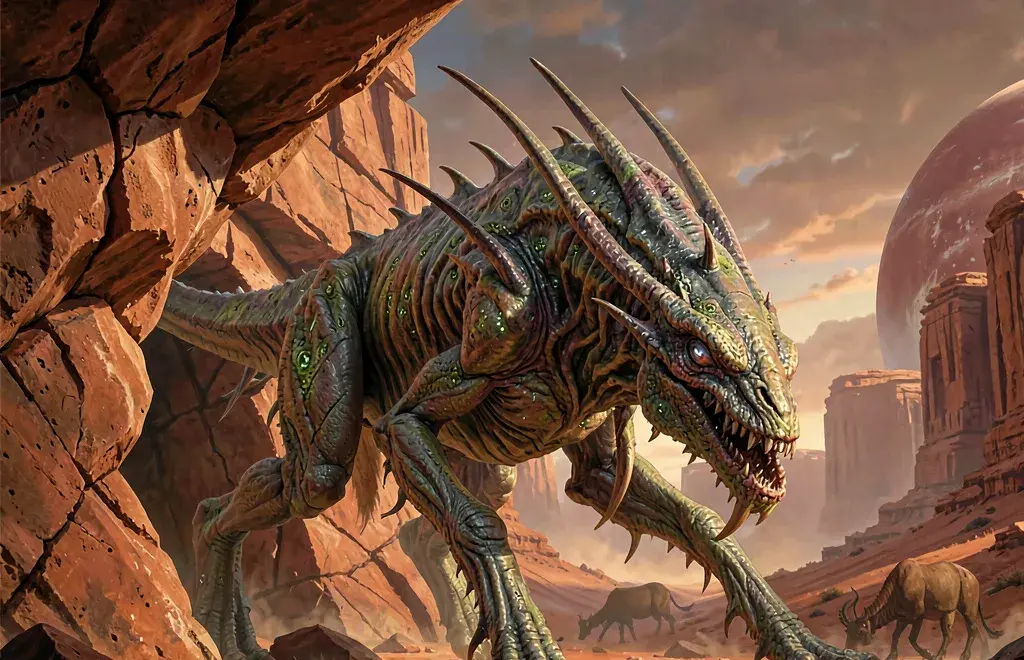
Lithovaga predax mimics Ares-Prime’s rusted crust, its silicate carapace hiding silently within deep tectonic fissures for weeks. Masking thermal signatures perfectly, these ambush predators detect approaching grazers via sensory filaments sensing subtle regolith vibrations at twilight hours. When rare prey enters range, a deadly Stalker erupts from stone with terrifying speed, crushing armored exoskeletons via powerful hydraulic legs. Solitary hunters consume massive biomass portions before retreating to shadowed crevices for full digestion. These dominant apex predators maintain crucial ecological balance among slower surface fauna on this harsh, iron-rich, dusty desert world.
World Data
- star
- K-Type Orange Dwarf
- gravity
- 1.8g
- atmosphere
- Thick CO2/Sulfur (10 atm)
- temp
- Warm (15-25 C)