
Kaelus-Prime
Hyper-arid Dust-Storm Super-Earth
Life on Kaelus-Prime · 4 species

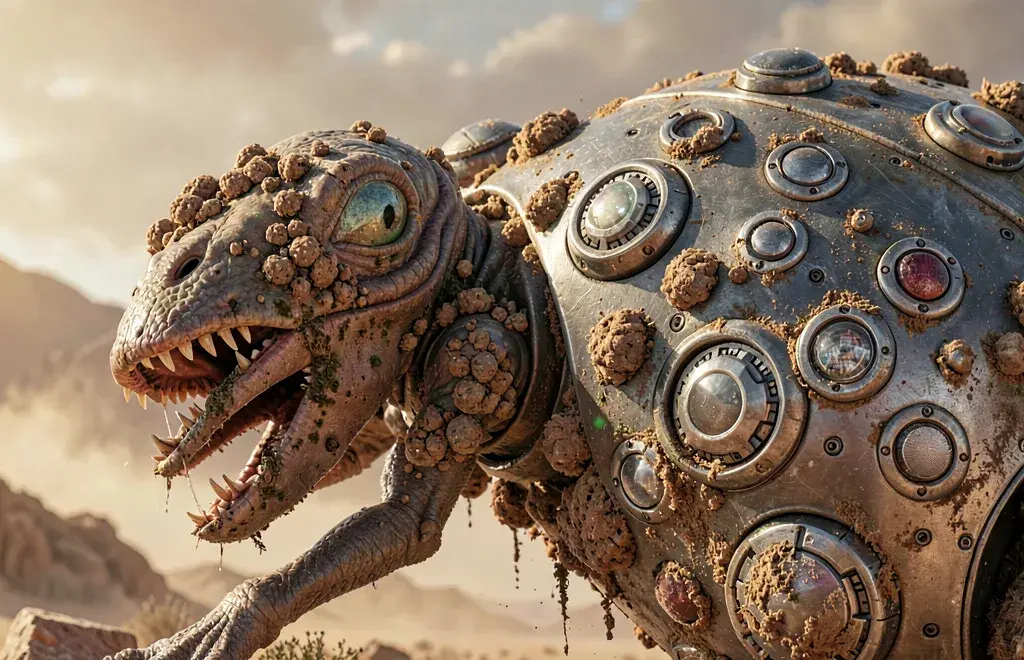
The Grit-Leech (*Sorbus granula*) is a microscopic colonial organism endemic to Kaelus-Prime's hyper-arid wastelands, forming living patches on the armored skin of the giant Vestix. These symbiotic clusters drift across the host's carapace during dust storms, utilizing specialized cilia to vacuum abrasive silicates from deep crevices. By filtering the choking grit before it settles, they prevent catastrophic sensor degradation in their massive hosts while feeding exclusively on the mineral-rich residue. Their translucent, gelatinous bodies shift hue from slate-gray to rust-brown depending on the mineral composition of the dust ingested. Though individually frail, the colony functions as a single hyper-efficient cleaning unit, maintaining critical mechanoreceptive function for the Vestix. In return for this essential hygiene, the leeches gain stability and protection within the host's electrostatic field, thriving where free-floating life cannot survive the relentless scouring winds.
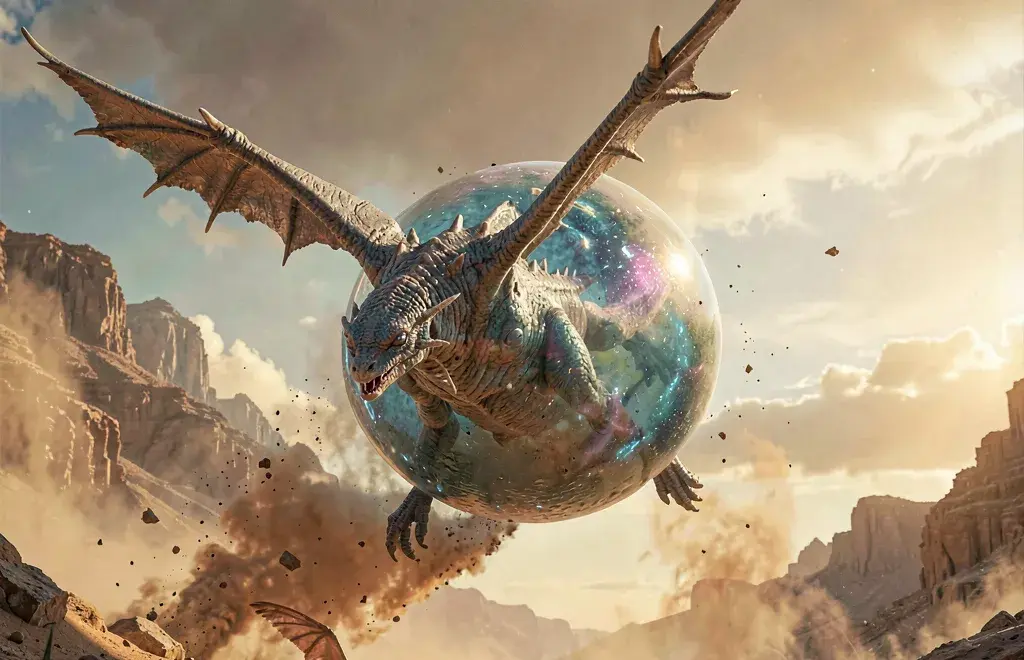
The Storm-Wing (*Aeris volatus*) is a semi-aquatic leviathan adapted to Kaelus-Prime's hyper-arid upper atmosphere. Resembling a translucent, hydrogen-filled balloon, it harvests static charge from swirling dust currents to maintain buoyancy within the planet's perpetual gale layers. Its gelatinous body filters microscopic moisture and organic particulates directly from the airborne haze, functioning as both filter-feeder and atmospheric drifter. However, this aerial existence hinges entirely on wind velocity. When gusts subside below critical thresholds, the creature loses lift and plummets into the lower dune zones. There, it becomes helpless prey for opportunistic Dune-Burrowers, whose subterranean ambush tactics exploit these predictable atmospheric lulls to capture the falling giants before they can re-inflate or escape.
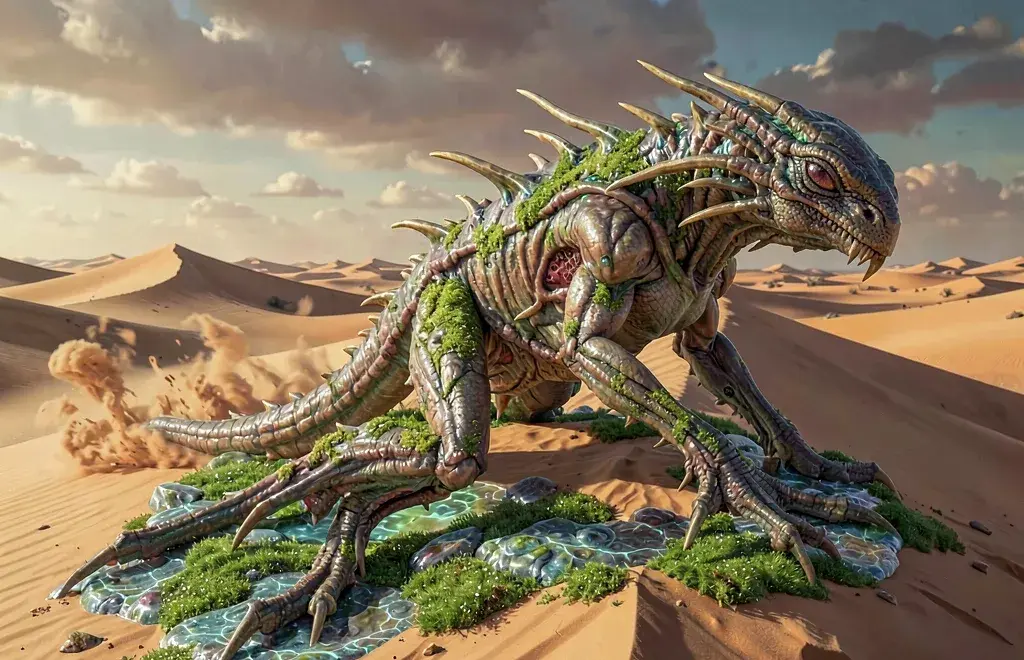
Lithos tessera manifests as a brittle, silicate-mottled crust encrusting Kaelus-Prime's shifting dunes. This hyper-arid super-Earth sustains no traditional vegetation; instead, the moss-like lattice performs slow photosynthesis, binding loose regolith against planet-wide dust storms. Its crystalline structure absorbs solar radiation while releasing trace moisture, creating micro-habitats essential for local fauna. Beyond stabilization, the crust serves as a vital camouflage substrate for the reclusive Vestix predators, whose speckled hides perfectly mimic the tessellated stone patterns. By disrupting wind flow at the surface level, Lithos tessera reduces erosion rates by forty percent, effectively acting as the planet's only natural barrier against total desiccation.
World Data
- star
- Red Dwarf (M4V)
- gravity
- 1.4g
- atmosphere
- Nitrogen-Argon dominated, 4.5 atm surface pressure, laden with sub-micron silicate dust
- temp
- -40°C (night) to +65°C (day), thermal inertia driven by atmospheric opacity