
Cinder-Six
High-Gravity Dust Desert
Life on Cinder-Six · 4 species

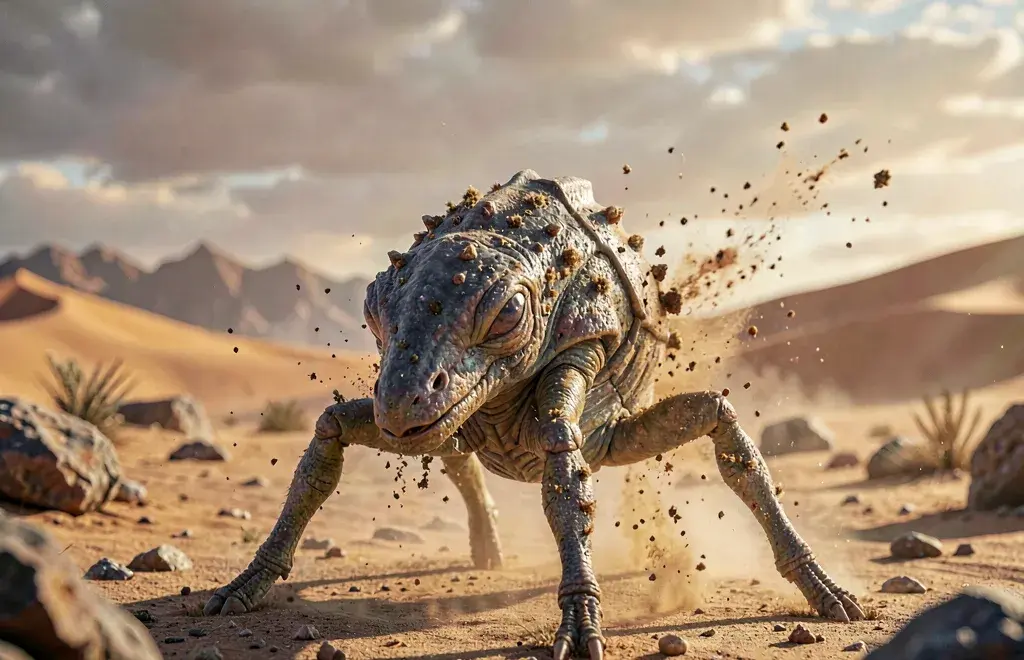
Lithovora arenus, the Silica-Grazer, thrives on Cinder-Six's high-gravity dunes as a compact, six-legged detritivore. Its carapace, reinforced with crystalline silica, shields it from abrasive sandstorms while its specialized mandibles grind silicate dust into fine particulate matter for digestion. These creatures act as the desert's mineral recyclers, excreting purified ceramic pellets that stabilize shifting dunes. Moving in low-slung herds, they filter atmospheric grit through internal gill-structures, converting barren dust into fertile soil crusts essential for the planet's sparse microbial life cycles.
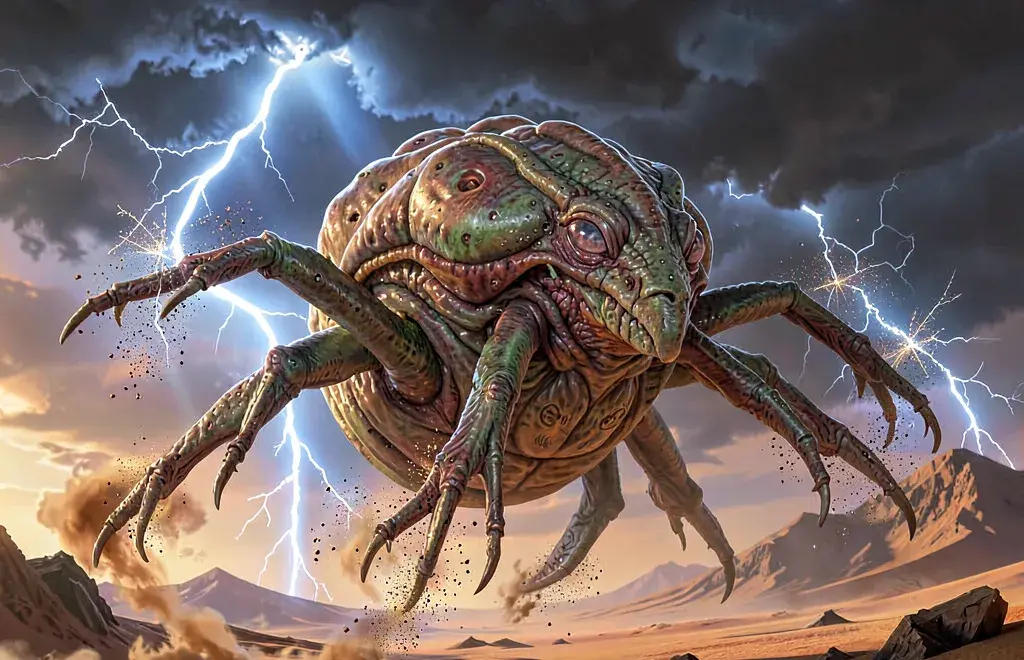
The Storm-Jelly (*Aetheria volans*) is a gas-bag organism uniquely adapted to Cinder-Six's crushing gravity and abrasive dust currents. Its translucent, silicate-reinforced sac expands to catch high-altitude updrafts, allowing it to drift passively across the desolate dunes. Despite its fragile appearance, the creature withstands intense static friction, acting as a living spore vector for the vital *Ionosoma* fungus between violent electrical storms. During periods of atmospheric instability, the Storm-Jelly ruptures slightly, releasing clouds of bioluminescent spores that hitchhike on lightning discharges. This mechanism ensures rapid colonization of nutrient-poor rock faces before the next dust storm buries them. Observers note its faint violet glow often precedes localized thunder, marking it not as prey, but as a crucial ecological bridge in this high-gravity wasteland.

Terrarix abysmus, the Deep-Shelter, navigates Cinder-Six's crushing gravity as a segmented subsurface worm, its obsidian carapace reinforced against high-pressure dust storms. Lacking eyes, it relies on thermal receptors to track Ionosoma moltings drifting through subterranean aquifers. The creature hunts by sensing the residual ionization of discarded exoskeletons, anchoring itself with barbed ventral plates to consume the sloughed matter. More than a scavenger, Terrarix acts as a biological heat sink within the arid crust. It actively absorbs waste thermal energy from nearby geothermal vents and decaying organics, converting this warmth into metabolic fuel that powers its slow, tectonic burrowing. This unique thermoregulation stabilizes local microclimates, preventing the superheated dust from destabilizing deeper strata while sustaining life in the planet's hostile depths.
World Data
- star
- Active K-type Flare Star
- gravity
- 1.4g
- atmosphere
- CO2, Argon, Suspended Iron Oxide
- temp
- -40C to 85C