
Zephyria Prime
Super-Earth Floating Archipelago
Life on Zephyria Prime · 4 species

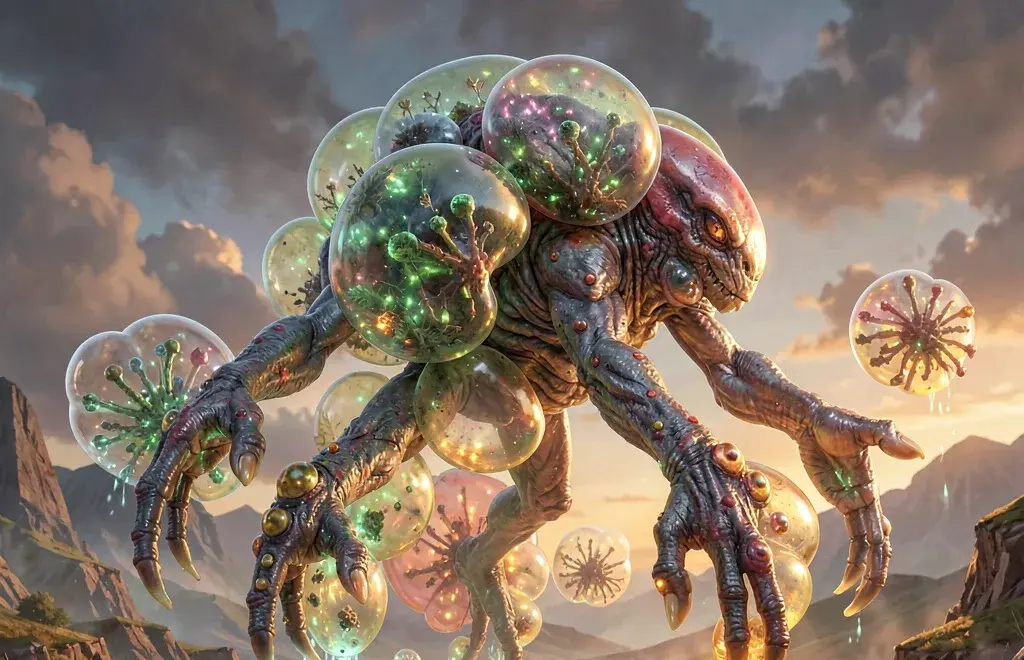
Methane-Drift (Gaseus volatus) forms vast, translucent colonies of interconnected gas-bags that drift lazily through Zephyria Prime's warm lower atmosphere. These aerial plankton rely on specialized chlorophyll analogs to harvest dim light from the super-Earth's haze layer, photosynthesizing methane and trace sulfur compounds into buoyant hydrogen. Their semi-permeable membranes shimmer with iridescent oil slicks, filtering nutrients directly from the air while maintaining neutral buoyancy against the planet's crushing gravity. Predators navigate these drifting meadows by detecting subtle chemical shifts as the colonies digest sulfurous plumes. During thermal updrafts, Methane-Drift fragments detach to seed new populations across the floating archipelago. Though seemingly fragile, their collective mass stabilizes regional air currents, acting as a living atmospheric filter that slowly converts toxic gases into breathable oxygen for smaller fauna below.
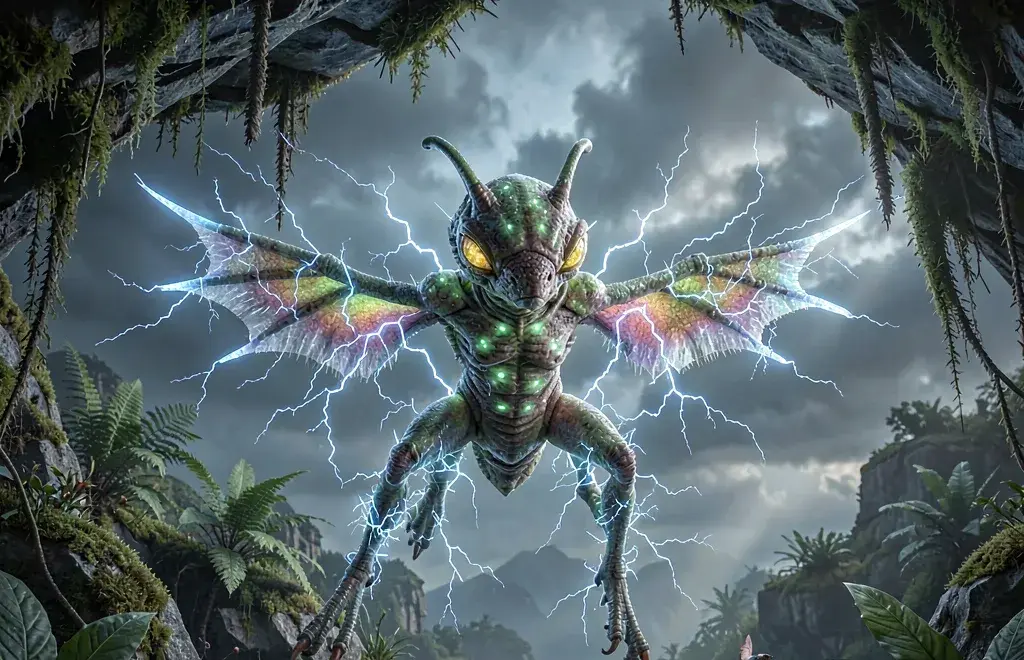
Ignis spora, or the Flare-Spore, drifts through Zephyria Prime's upper currents as a cluster of small, bioluminescent spheres. Lacking wings, these aerial consumers rely on thermal updrafts and their own generated static charge for buoyancy and defense. Each organism pulses with a soft violet glow, signaling its volatile nature to potential predators in the floating archipelago's dense atmosphere. Touching a Flare-Spore without proper insulation triggers an immediate, painful electrostatic discharge capable of stunning small avian hunters. This potent defense mechanism allows the species to thrive despite their lack of flight or speed. Field researchers must wear Faraday-lined suits when collecting samples, as even a graze can deliver a shock equivalent to a lightning strike on this super-Earth world.

Radix petra, or Anchor-Weed, dominates Zephyria Prime's floating archipelagos as a vast, moss-like mats of fibrous green. These sessile giants anchor directly into porous rock, their dense root systems filtering trace nutrients from the hyper-oxygenated atmosphere to sustain the ecosystem. Their slow growth creates a stable, living crust essential for survival in these drifting landmasses. The organism's primary ecological function is structural; its tough, spongy tissue provides the only viable substrate for Sky-Weavers to secure their nests without tearing through weaker stone. Without these massive filter-feeders, the floating islands would lack cohesion, causing the entire food web to collapse as avian predators lose their nesting grounds and prey species vanish from the sky-bound currents.
World Data
- star
- K-type Orange Dwarf
- gravity
- 0.65g
- atmosphere
- Nitrogen-Methane-Water Vapor (High Density, 3.5 bar surface equivalent at altitude)
- temp
- 280-310K (Thermal stratification critical)