
Kaelthas Prime
High-Gravity Super-Earth
Life on Kaelthas Prime · 4 species

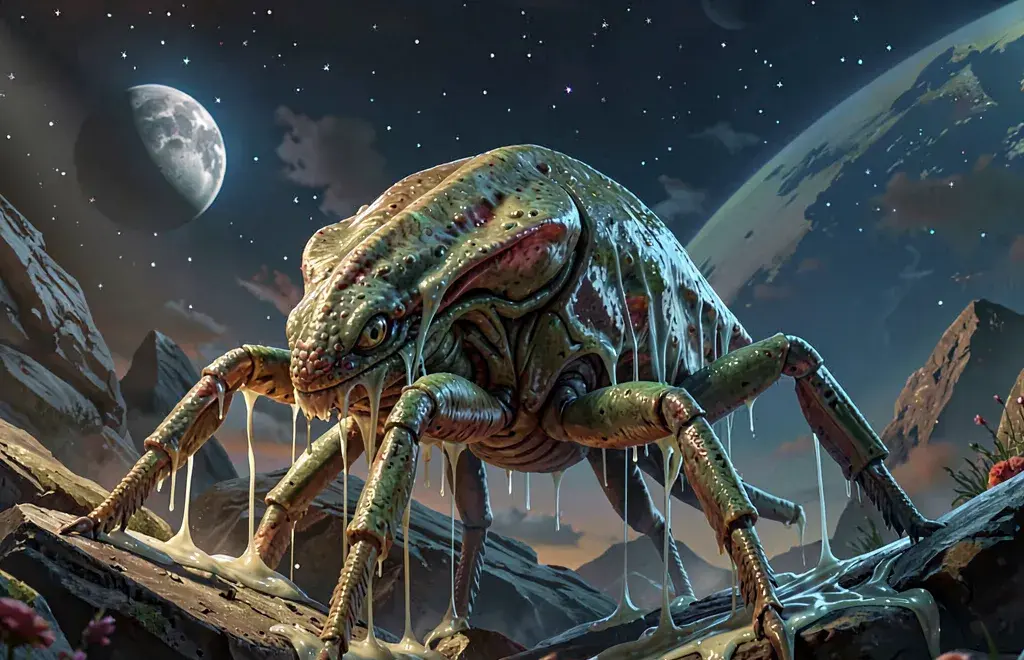
Scutellum gravitatis, or the Grav-Skitter, is a low-profile arthropod analogue adapted to Kaelthas Prime's crushing gravity. Its massive, flattened carapace distributes weight, allowing it to glide effortlessly along rock undersides where few predators venture. Six powerful, articulated limbs anchor the creature while suction-like pads generate friction against vertical surfaces. This heterotroph specializes in scavenging the nutrient-rich mucus secreted by the Slab-Weaver. By sliding beneath overhangs, it accesses these fresh deposits without disturbing its host. The Skitter's reduced profile and dense musculature enable rapid retreat into crevices when rock shifts occur, ensuring survival in this high-gravity, subterranean niche.
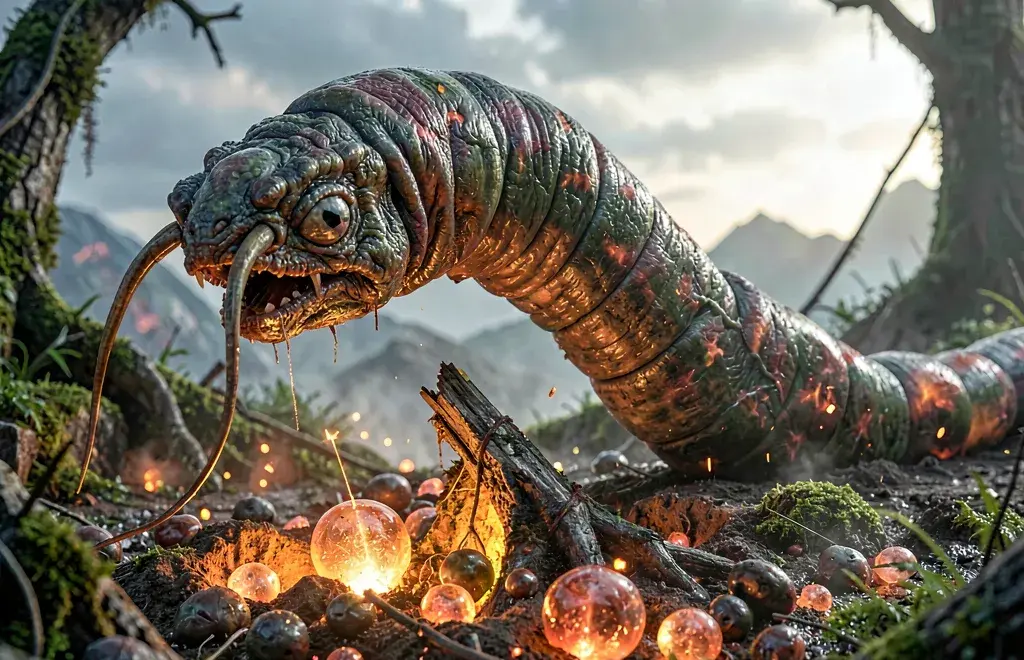
Ferrum-punctura manifests as a segmented, iron-hard worm highly adapted for crushing under immense gravitational stress. Chitinous plates gleam dull grey against the dense obsidian crust of Kaelthas Prime. These parasites nest within active native Slab-Weaver thermal vents, exploiting the host to access nutrient-rich strata deep below. Using a hardened rotary radula, they pierce the Weavers’ protective Thermo-Mesh to siphon concentrated radioactive isotopes specifically. This metabolic fuel sustains rapid cellular division despite constant crushing gravity. Removing the mesh destabilizes host thermal regulation, marking the Deep-Driller as lethal rather than harmless vermin.
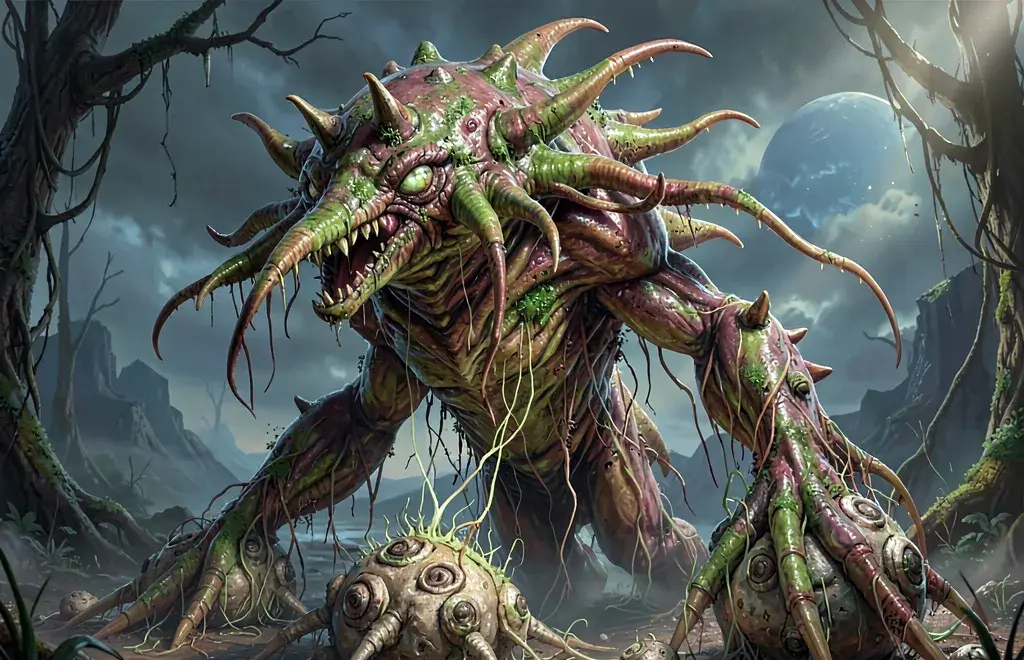
Fallax-radialis, or Spore-Burst, thrives in Kaelthas Prime's crushing gravity as a specialized decomposer, targeting the calcified seed-stones of deceased Slab-Weavers. Its mycelial network infiltrates these dense, stone-like husks, secreting potent enzymes that rapidly dissolve their rigid matrices under high-pressure conditions. This biological alchemy transforms inert geological remnants into nutrient-rich slurry, essential for sustaining the planet's subterranean ecosystems. Once digestion concludes, the organism triggers a violent release of pressurized spores. These microscopic vectors are ejected deep into the crust through fissures, effectively repopulating the lower strata with genetic material. This cyclical mechanism ensures that the Slab-Weaver's legacy is not lost but recycled, maintaining the delicate equilibrium between surface decay and deep-earth regeneration on this volatile super-Earth.
World Data
- star
- K-type Orange Dwarf (High Flare Activity)
- gravity
- 2.4g
- atmosphere
- Dense Nitrogen-Carbon Dioxide with trace Radon; Surface pressure 4.5 atm
- temp
- 15°C to 25°C (Thermally stable due to thick atmosphere)