
Magnetis Prime
Magnetar-orbit rocky super-Earth
Life on Magnetis Prime · 4 species

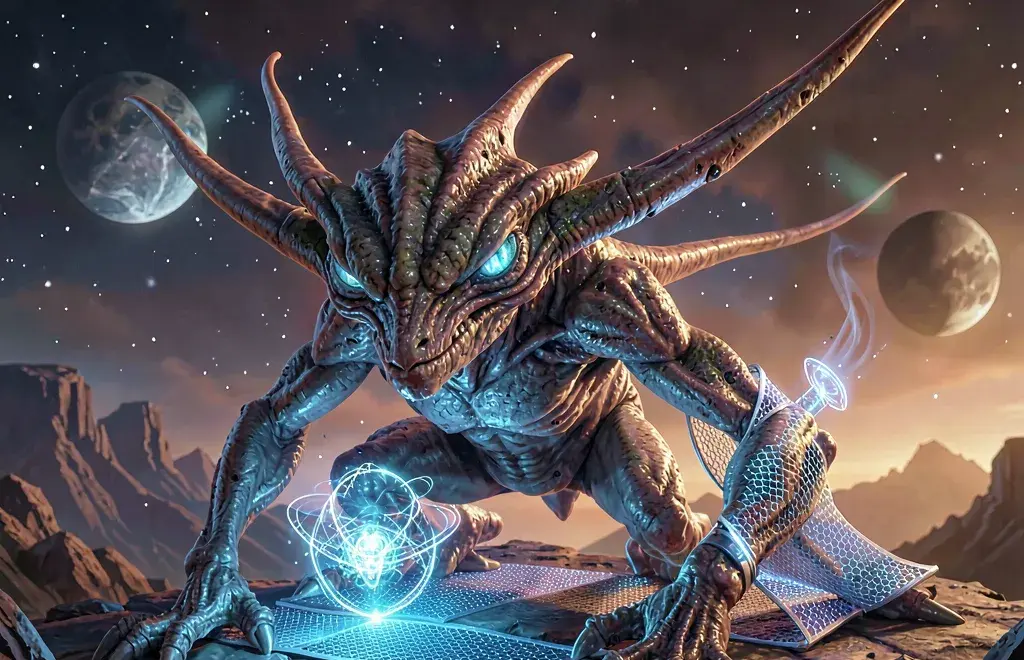
Lithos veinus anchors itself to Magnetis Prime's iron-rich crust via sprawling, conductive root-mats that double as structural braces against planetary shear. These silicate-laced filaments absorb ambient magnetic flux from the orbiting Gyrion star, converting lethal radiation into stable kinetic energy to fortify the host's exoskeleton. In return, the symbiotic conductor regulates local geomagnetic fields, creating a protective bubble that shields both organisms from solar flares. This mutualism allows Lithos veinus to thrive in an environment where unanchored life would be instantly shredded by magnetic storms, turning a hostile magnetar orbit into a viable sanctuary.
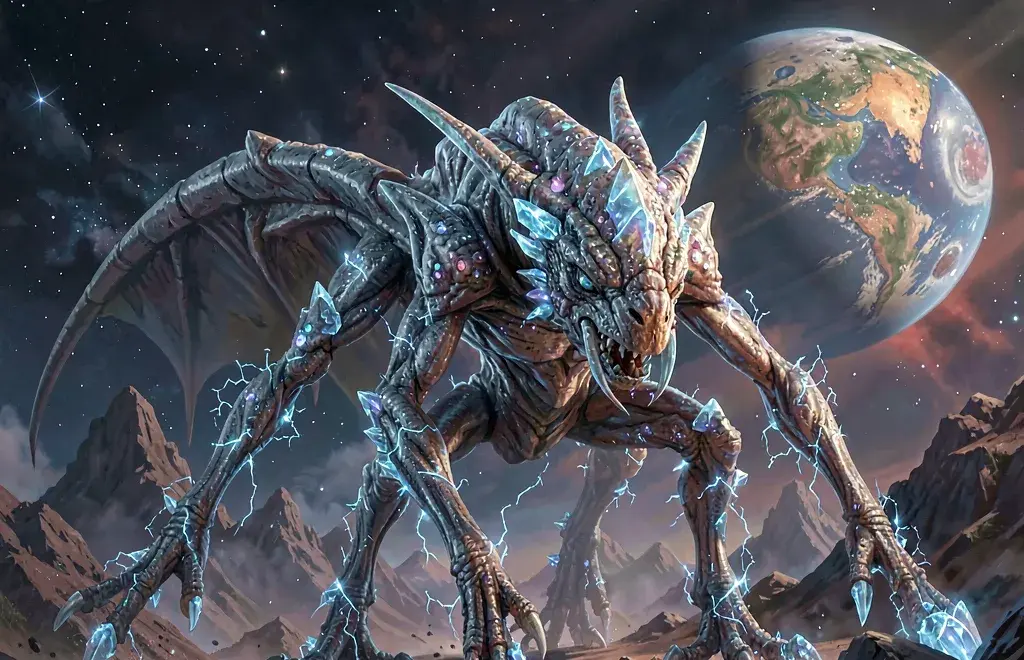
The Ion-Shard (Ion shardis) is a rigid, jagged organism of fractured silicate and piezoelectric crystal, anchored to Magnetis Prime's iron-rich crust. Unable to traverse the planet's violently shifting magnetic gradients, it survives as a static scavenger, passively harvesting ambient electrical surges generated by the orbiting magnetar. Its multifaceted body acts as a colossal lightning rod, converting erratic atmospheric potential into metabolic energy while enduring constant electrostatic bombardment. During intense solar flares, these creatures glow with a bruised violet luminescence, their crystalline surfaces sparking as they absorb lethal voltages. Though immobile, their dense, conductive structures allow them to outcompete mobile fauna in the high-radiation zones where shifting fields render traditional hunting impossible. They persist as silent, glowing sentinels, feeding on the very chaos that would destroy lesser lifeforms.
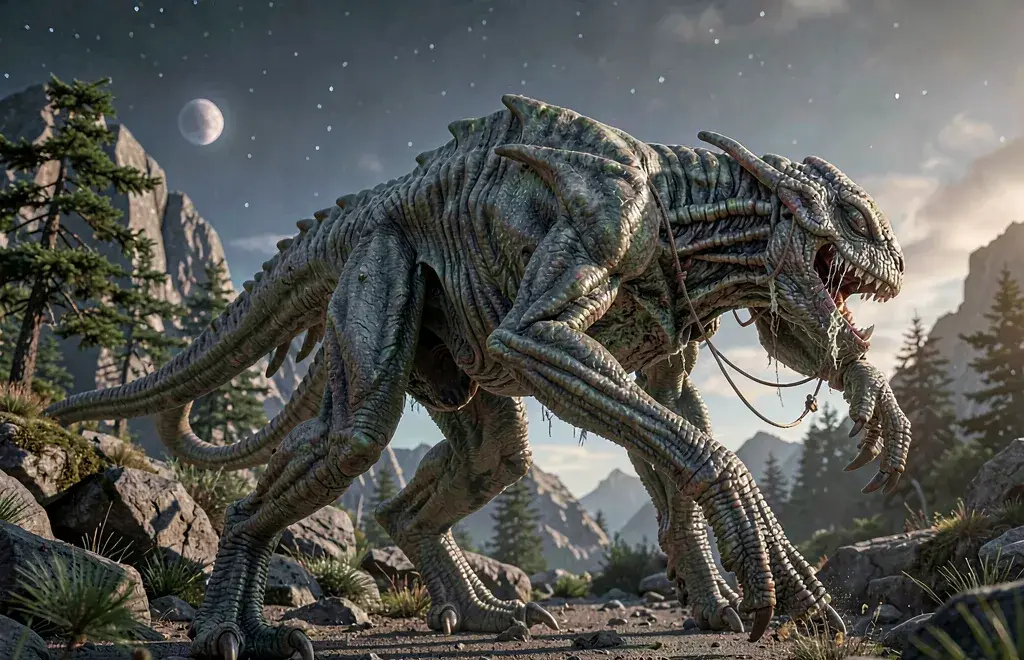
The Void-Phage (Phaga voidis) lurks within Magnetis Prime's ferrous crusts, a sleek, obsidian predator evolved to exploit the planet's crushing magnetic field. It hunts Gyrions, energy-dependent grazers, by projecting localized magnetic nulls that sever their bio-electric lifelines. This sudden starvation induces immediate neural collapse in prey, leaving them inert before the Phage consumes their residual charge, rendering its own presence a silent, deadly void in the ambient radiation. Field teams report that these disruptions manifest as sudden "dead zones" where compasses spin wildly and sensors fail. The creature moves with unnerving silence through high-gravity canyons, its carapace dampening electromagnetic signatures to avoid detection by both prey and native fauna. Caution is advised: approaching a suspected null zone risks total equipment failure and exposure to the Phage's feeding cycle.
World Data
- star
- Magnetar (PSR J1745-2900 analog)
- gravity
- 2.2g
- atmosphere
- Supercritical Argon-Plasma mix
- temp
- -40 Celsius