
Aethelgard
Binary Terrestrial (S-Type)
Life on Aethelgard · 4 species

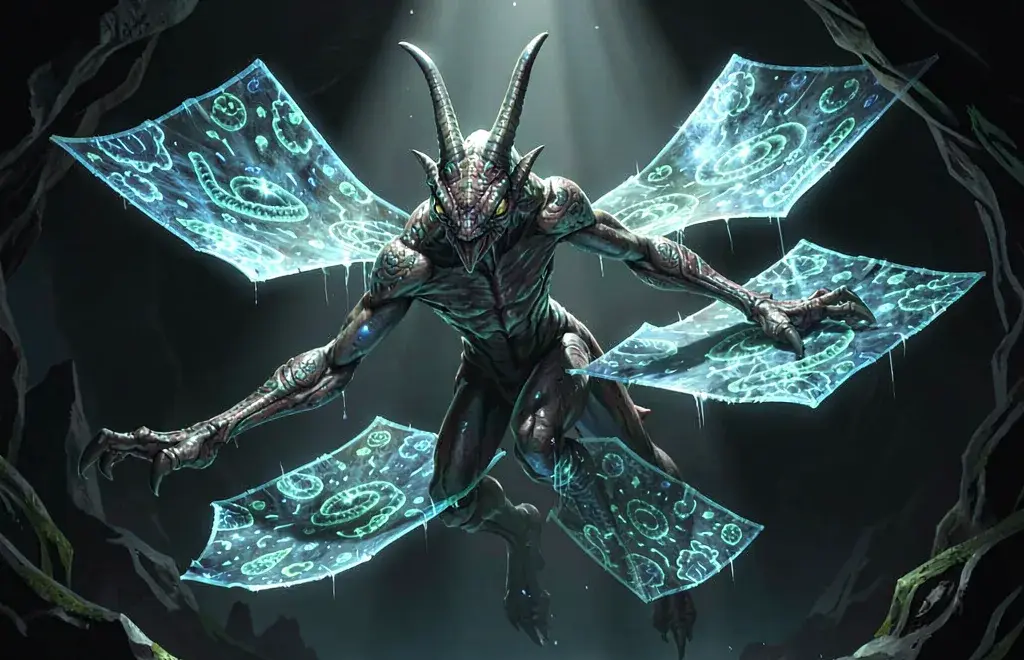
Lanternis filum manifests as drifting mats of bioluminescent bacteria, uniquely adapted to Aethelgard's binary star system. These Primary Producers thrive exclusively within single shadows cast by one sun, metabolizing atmospheric sulfides while emitting a soft, amber glow that illuminates the upper atmosphere. Their photosynthetic pigments absorb the weaker stellar spectrum, sustaining vast aerial ecosystems in perpetual twilight zones where traditional flora cannot survive. However, entering a double shadow—where both stars are eclipsed—triggers an immediate camouflage response. The bacteria cease bioluminescence and retract their reflective structures, rendering Lumin-Weave nearly invisible against the darkened sky to avoid predation by crepuscular grazers. This dual-state existence allows the species to dominate the planet's atmospheric layers, acting as both a vital light source and a ghostly transient depending on celestial alignment.

Umbra volans is a translucent, gelatinous mass buoyed by large internal helium bladders. Blind to light, it navigates complex thermal gradients within Aethelgard’s permanent terminator zone. Grazing on shadow-moss along the twilight line, it constantly avoids illumination which ruptures its delicate membranes. During orbital alignments, crepuscular zones converge rapidly. Drifters panic violently when distinct shadows overlap, sensing an unstable thermal cover. Frantic thrashing disperses herds into bright daylight, causing immediate severe lethal exposure. Researchers advise maintaining localized artificial shade corridors during every syzygy to prevent population collapse from light-stress predation.
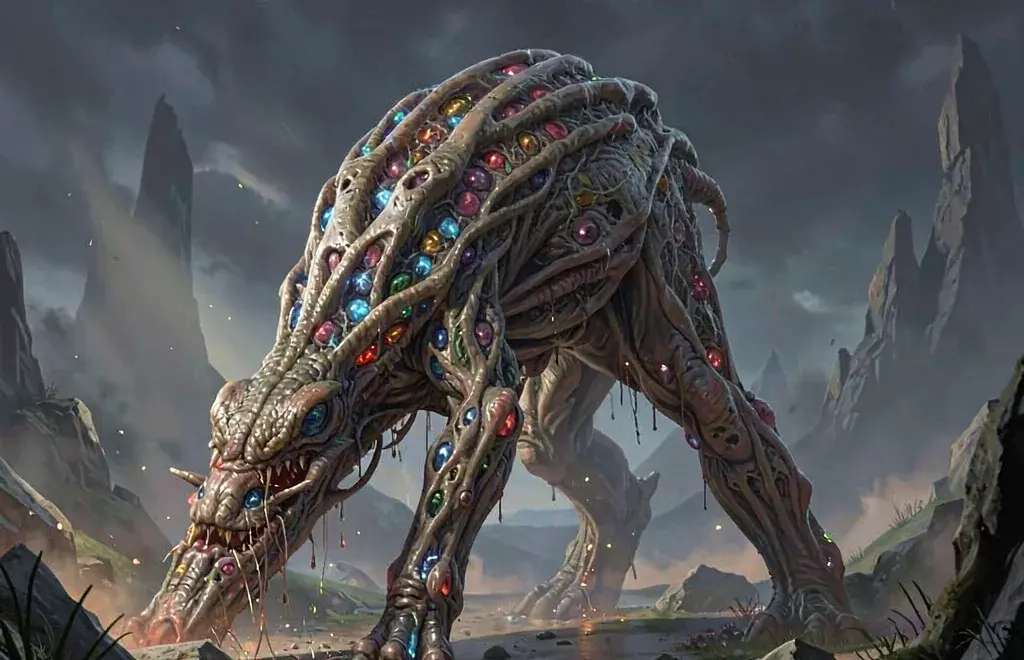
Cavum silt appears as a cluster of jagged, obsidian-like formations embedded within Aethelgard's basalt plains, indistinguishable from the surrounding geology until motionless observation reveals subtle thermal pulsations. These stationary decomposers anchor themselves firmly, extending microscopic silicate filaments to detect the residual electromagnetic signature of deceased T. bifax predators nearby. Upon locating a carcass rich in accumulated heavy metals, the organism secretes a potent chelating acid that liquefies the predator's dense tissues. The Cavum silt absorbs these toxic minerals directly through its porous crust, effectively neutralizing environmental hazards while recycling rare elements back into the ecosystem, leaving behind only sterile, mineral-free ash within hours of consumption.
World Data
- star
- Primary K0V (Orange) + Secondary M4V (Red) in 45-day orbit
- gravity
- 1.4 g
- atmosphere
- High-Nitrogen, 4% Argon, trace Sulfur Hexafluoride (SF6) for buoyancy assistance in dense lower layers
- temp
- Global mean 280K; extreme thermal gradients at terminator zones