
Lithos-Prime (Shelf Sector 4)
Supercontinent Coral-Reef Shelf Planet
Life on Lithos-Prime (Shelf Sector 4) · 4 species

The Seismic Seed (*Fragmenta tectonica*) is a pressurized, silicate-shelled projectile ejected from mature coral-moss colonies across Lithos-Prime's reef shelves. Roughly the size of a fist and gleaming with obsidian facets, this independent offspring travels ballistically before impacting the supercontinent's crust. Its internal lattice stores immense tectonic tension, designed to shatter instantly upon contact with solid rock or competing flora. Upon detonation, the seed triggers localized micro-earthquakes that fracture the substrate, clearing dense vegetation and creating fresh crevices for germination. This violent dispersal mechanism allows *F. tectonica* to colonize the rigid shelf sectors of Sector 4, turning seismic energy into fertile ground while ensuring the parent colony expands its territory through controlled geological disruption.
The Resonance Leech (*Vibrio parasitus*) is a diminutive, translucent vermiform resident of Lithos-Prime's Coral-Reef Shelf. It navigates the planet's crystalline lattice by sensing minute vibrational frequencies, burrowing deep into the silicate matrix where it anchors its proboscis directly into piezo-enzymatic conduits. Unlike terrestrial parasites that consume blood or tissue, this organism siphons kinetic resonance, effectively short-circuiting the host rock's internal energy generation. Infested sectors rapidly succumb to localized metabolic starvation as their vibrational output plummets. Without the sustaining hum of piezoelectric flux, the lattice loses structural integrity, leading to sudden, brittle collapse that mimics spontaneous geological failure. Field teams must scan for anomalous silence within the reef's ambient song; where vibration ceases, the Leech has already begun its silent dismantling.

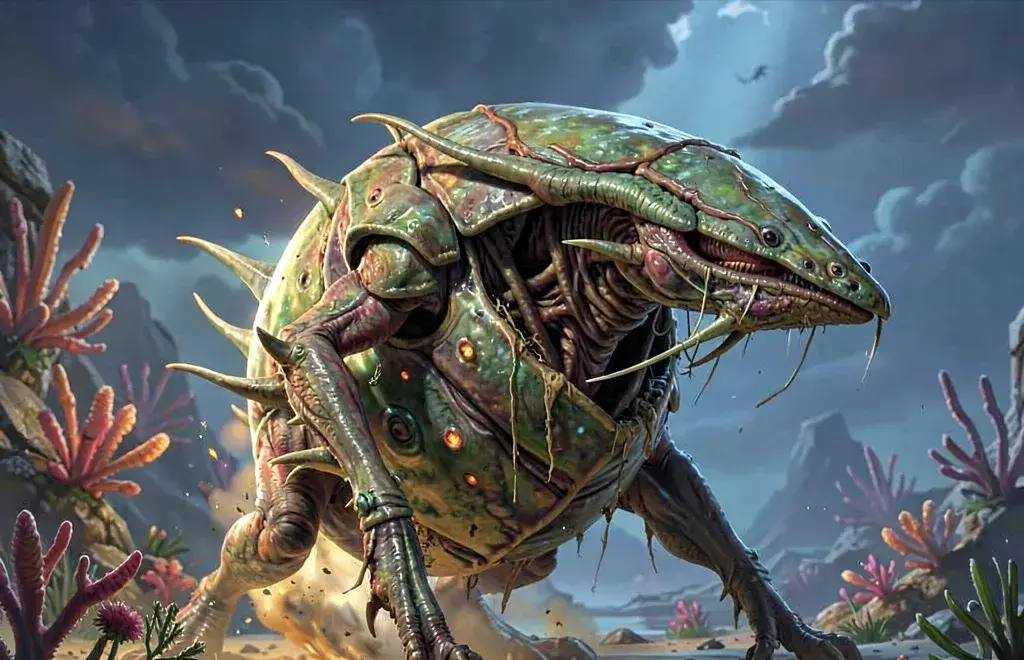
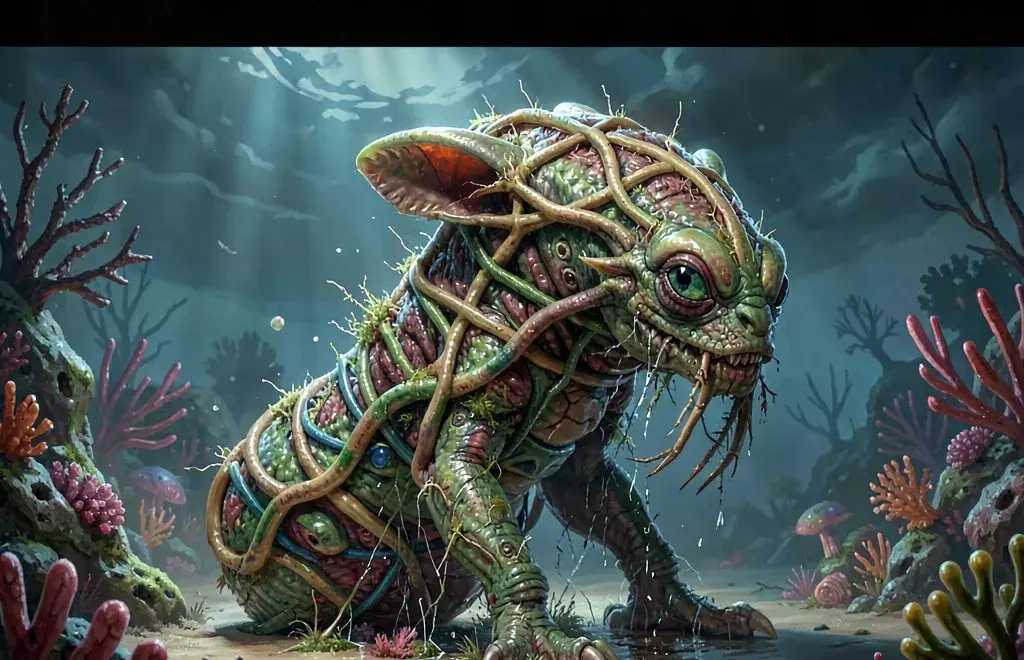
The Crust-Grazer (*Litho-mors*) is a low-slung, armored hexapod native to Lithos-Prime's coral-shelf supercontinent. Its chitinous plates glisten with mineral deposits as it navigates the vast, living lattice of the planet's crust. Using specialized mandibles, these small herbivores harvest soft, enzymatic secretions from the bio-rock structure, a nutrient-rich fluid essential for their survival in this harsh environment. However, their grazing inadvertently triggers the host lattice's immune response, forcing localized calcification that seals off the grazed area while redirecting stress fractures elsewhere. This defensive mechanism often leaves the *Litho-mors* trapped beneath rapidly hardening stone or exposed to predatory scavengers drawn by the chemical distress signals, making them a fleeting yet vital component of the shelf ecosystem's chaotic balance.
World Data
- star
- K-type Orange Dwarf
- gravity
- 1.6g (High)
- atmosphere
- Nitrogen-Methane heavy, high density, low oxygen
- temp
- 280K-310K (Thermally stable due to thick atmosphere)
- pressure
- 3.5 atm at sea level