
Aethelgard
Supercritical Fluid Archipelago
Life on Aethelgard · 4 species


The Gastromat (*Pneumofungus volans*) dominates Aethelgard's supercritical skies as a colossal, buoyant fungal mat. Its porous hyphae trap atmospheric gases to maintain neutral buoyancy within the dense fluid layers, creating vast, drifting archipelagos of biological substrate. These floating islands anchor themselves against high-velocity winds through flexible, tensile root-strands that harvest trace nutrients directly from the surrounding medium. Serving as the ecosystem's primary producer, the Gastromat supports diverse grazers by offering a stable platform and nutrient-rich mycelial surface. Herbivorous drifters traverse its undulating cap, grazing on the outer crust while the mat slowly regenerates beneath them. This symbiotic relationship stabilizes local atmospheric currents, turning the creature into both a mobile habitat and a vital energy reservoir for the planet's aerial biosphere.
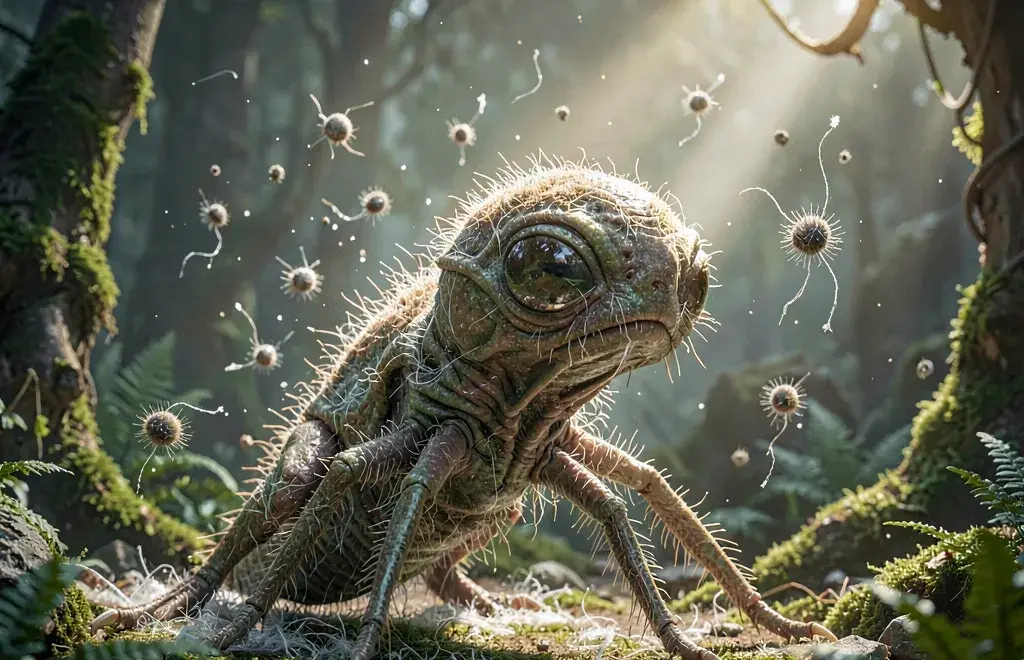
*Aeromicro parvus*, the dust-mite, navigates Aethelgard’s supercritical atmospheric envelope. These translucent entities hover within high-pressure jet streams, utilizing ciliated membranes to capture particulates. Their bodies shimmer with refractive silica deposits, camouflaging them against the crystalline haze while remaining invisible to thermal predators. Primarily scavengers, they filter shed silica fibers from currents generated by tectonic vents. Colonies process cubic kilometers of atmosphere daily, extracting nutrients from microscopic detritus before dispersing progeny into the wind. Their existence defines the continuous atmospheric nutrient cycle, turning rock-shed into biomass in this vast fluid realm.
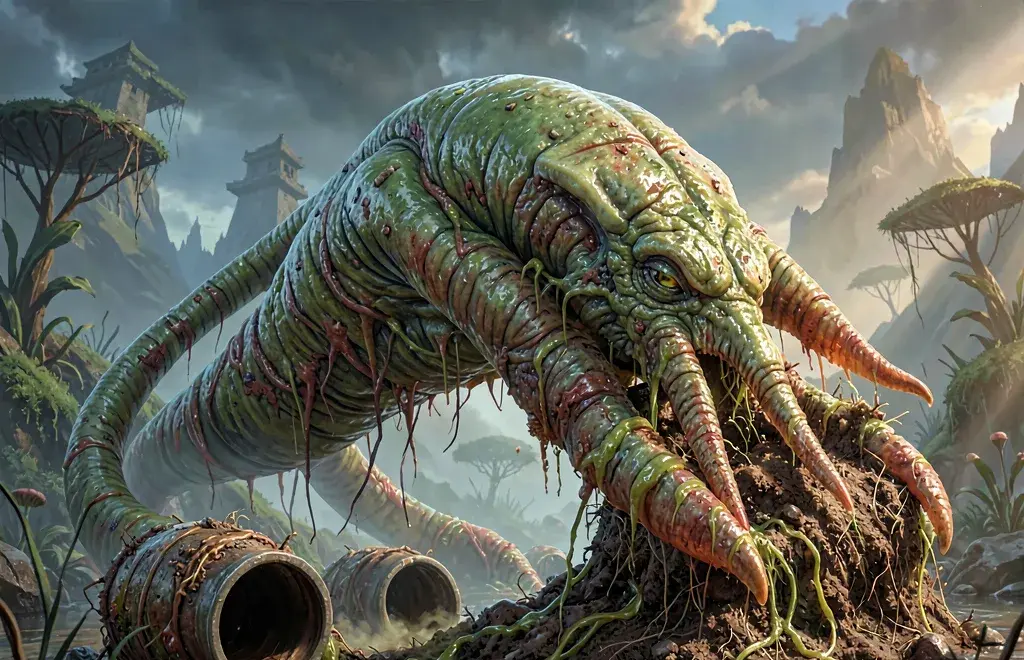
The Spore-worm (*Sporofila filum*) thrives within the high-pressure depths of Aethelgard's Archipelago, tunneling exclusively into abandoned Gastromats. These translucent, gelatinous husks serve as both shelter and primary sustenance for the creature. Its segmented, semi-translucent body secretes specialized enzymes that rapidly dissolve the complex polymers of spent biological matter, operating efficiently under supercritical fluid conditions where standard decomposers would fail. As it burrows through the decaying matrix, *Sporofila* converts inert waste into bioavailable nutrients, releasing them directly back into the ambient flow. This process revitalizes the local ecosystem, seeding new microbial blooms that sustain higher trophic levels. The worm's rhythmic undulations create subtle pressure waves, signaling its presence to other recyclers while ensuring no organic material goes unprocessed in this volatile, fluid world.
World Data
- star
- Red Dwarf (M4V), dim and red-shifted
- gravity
- 0.4g (Low gravity essential for buoyancy)
- atmosphere
- Supercritical Nitrogen/CO2 fluid; density 0.8g/cm3 at altitude; conductive ionic haze
- temp
- -10C to +5C (Perpetual twilight zone)