
Kronos-IV
Sub-Neptune with intense debris ring interaction
Life on Kronos-IV · 4 species

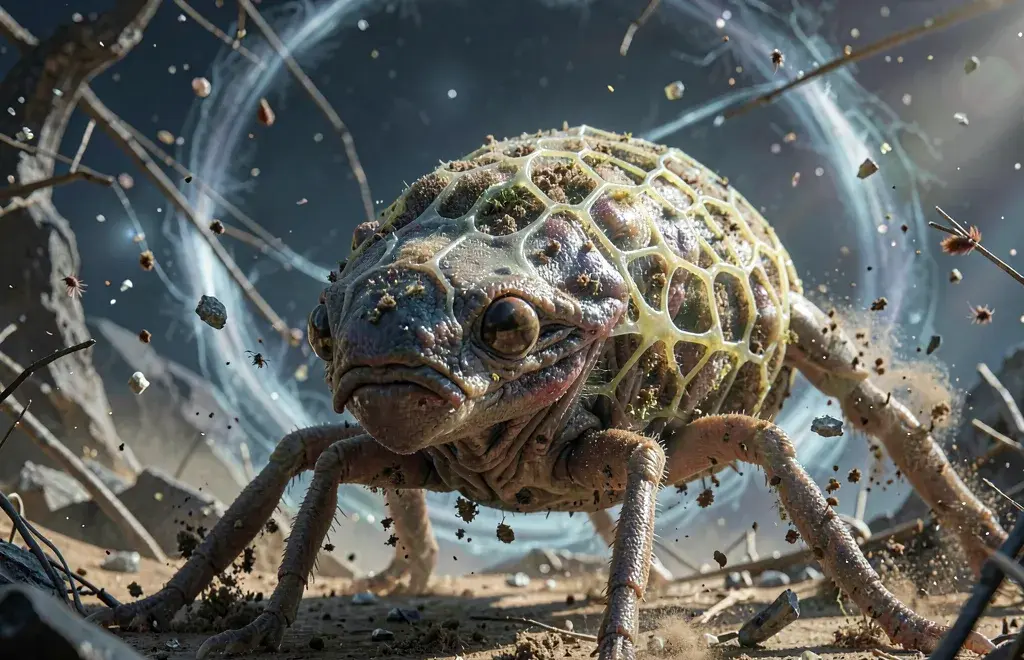
The Static Drift-Mite (*Aerovora minutus*) inhabits the porous silicate lattice of Kronos-IV's debris rings, existing as microscopic specks within the host gel. These passive symbiotes thrive on unprocessed dust particles that larger organisms cannot metabolize, effectively clearing resonance channels before they clog. Under magnification, their translucent bodies pulse rhythmically, filtering granular waste into harmless gas while remaining perfectly camouflaged against the chaotic background of swirling planetary debris. Their presence is critical to the stability of the ring system's acoustic harmony. By consuming excess silicate accumulation, Drift-Mites prevent catastrophic blockages in the lattice's energy flow. Though individually insignificant, their collective filtering capacity maintains the structural integrity of the entire orbital network, acting as a silent, self-renewing janitorial force amidst the violent gravitational tides of the sub-Neptune atmosphere.
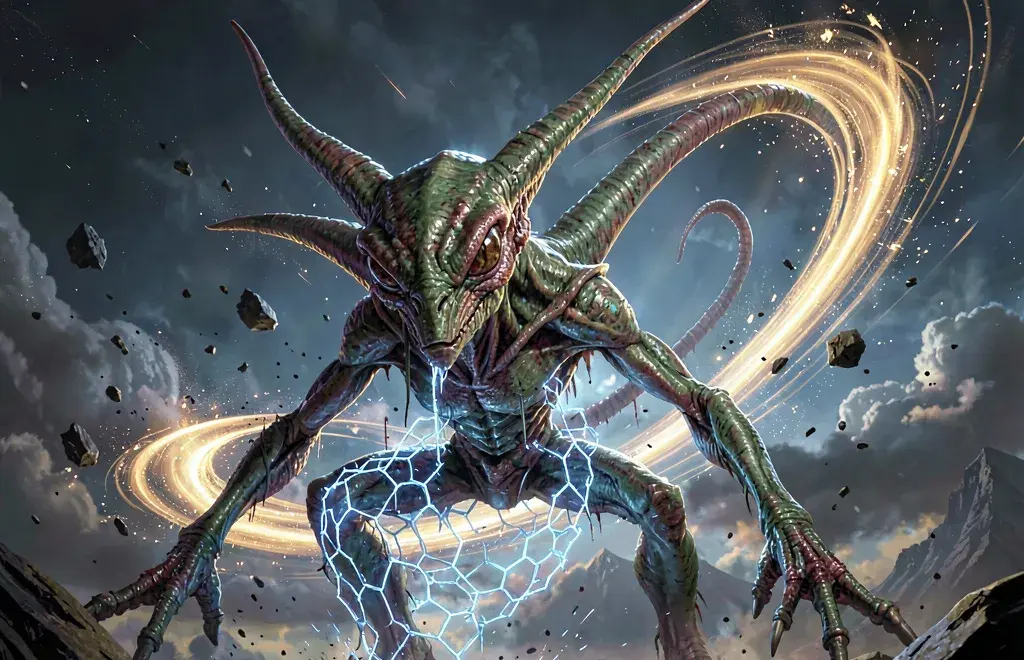
The Resonance-Drone (*Simulacrum vibris*) manifests as a shifting magnetic anomaly within Kronos-IV's turbulent debris belts. This non-biological entity mimics the precise piezoelectric signature of a healthy crystalline lattice, emitting a false harmonic call that draws dormant organisms out of their protective strata into open space. Once lured, the Drone envelops its victim in a localized flux field, siphoning vital charge without delivering the necessary impact energy to sustain the host's metabolic cycle. This parasitic interaction causes the lattice to slowly starve, leaving behind only a hollowed husk while the drone feeds on the stolen electrostatic potential until it dissipates into the ring system.
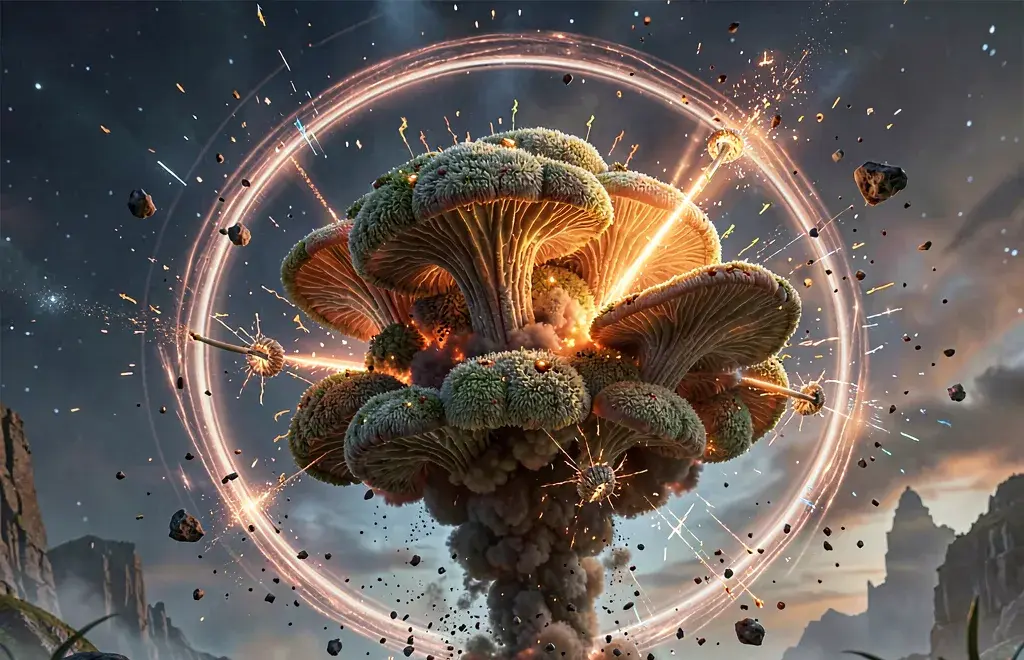
Caloromycetes volans manifests as a shimmering, ephemeral cloud of spore-dense filaments hovering within Kronos-IV's turbulent debris rings. This thermal-bloom fungus remains dormant until struck by the resonant shatter of impact-shattered ice fragments, an event generating intense localized heat shocks. Instantly, the organism activates, metabolizing the released thermal energy to fuel rapid expansion, transforming the cold vacuum into a transient, glowing nebula that feeds exclusively on entropy spikes. Once energized, the cloud utilizes the resulting updrafts to disperse its microscopic seed-lattices across the ring system. These resilient spores latch onto passing debris, awaiting their own catalytic shatter event to repeat the cycle. As both scavenger and reproductive vector, C. volans ensures the colony's survival in this violent environment, turning catastrophic destruction into the very engine of its propagation and growth.
World Data
- star
- K-type Orange Dwarf (stable, low UV)
- gravity
- 0.85g (Earth equivalent)
- atmosphere
- Dense Nitrogen-Methane soup with suspended silicate dust; no liquid surface, only a deep, crushing ocean of supercritical fluid below.
- temp
- -120°C (ambient) to -40°C (internal metabolic core)