
Aethelgard Nebula
M4V Red Dwarf with dense, optically thick emission nebula (HII region)
Life on Aethelgard Nebula · 4 species

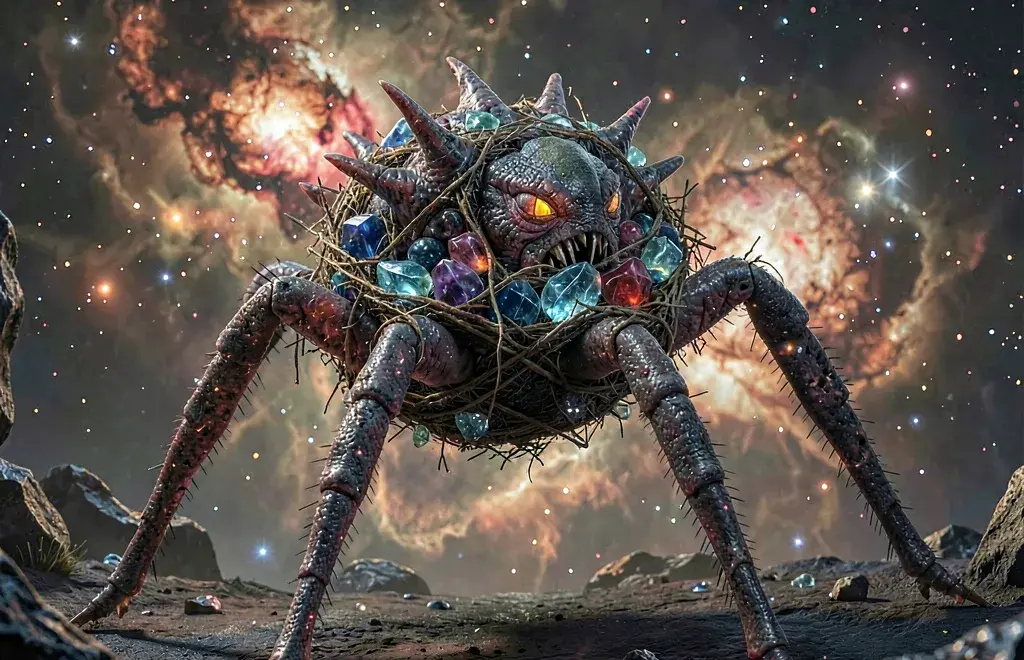
Sulfolithus arachne, the Ash-Weaver, navigates Aethelgard's perpetual twilight as a six-legged heat-resistant invertebrate. Thriving within dense HII clouds surrounding its M4V star, this basal decomposer scavenges volcanic vents, its chitinous carapace darkened to absorb residual thermal radiation while shielding against intense particulate bombardment. Using specialized mandibles, the creature weaves intricate nests from rapidly cooling volcanic glass. These silica structures act as both sanctuary and filtration system, trapping mineral-rich ash as it settles through the nebular mist. By digesting trapped silicates and heavy metals, the Ash-Weaver converts toxic dust into biomass, sustaining the local ecosystem's nutrient cycle amidst the star's acidic haze.
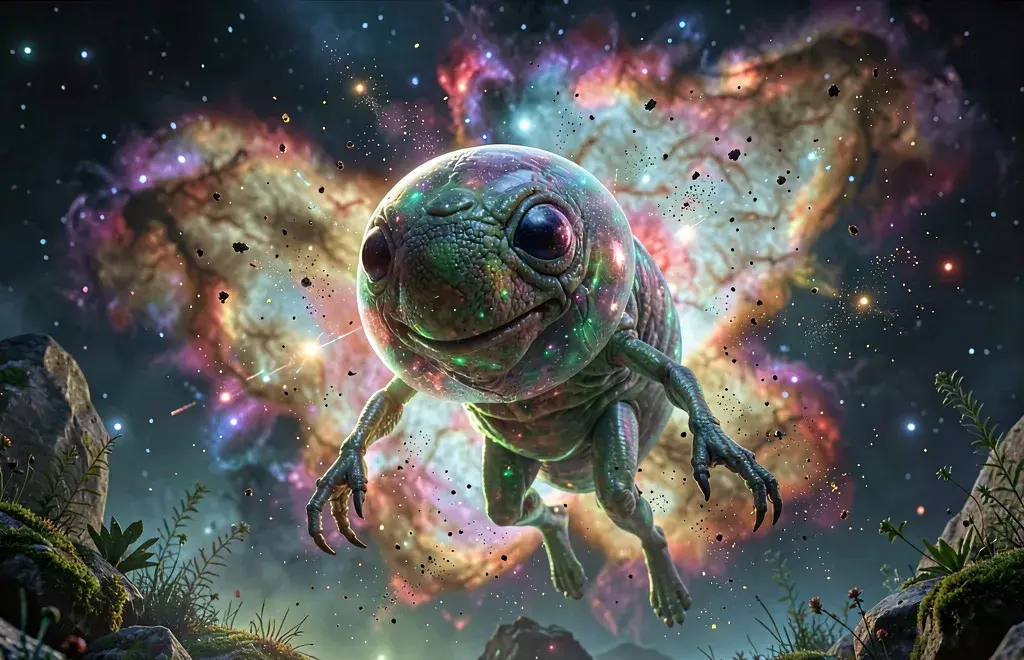
Nebuloides volans, the Neon-Drifter, is a gelatinous, balloon-like primary consumer buoyant within Aethelgard's dense lower atmosphere. Its translucent epidermis acts as both filtration membrane and photoreceptive organ, extracting microscopic spores from the turbulent air while absorbing faint red-shifted photons leaking through the optically thick HII region. This dual metabolic strategy sustains its slow drift in perpetual twilight, where internal bioluminescent veins pulse rhythmically to attract symbiotic microbes that further digest trapped organic matter. Observers note their graceful undulation against a backdrop of crimson gas clouds, appearing as living lanterns suspended on thermal currents. During stellar flares from the M4V host star, Drifters contract their bodies to minimize radiation exposure, retracting delicate feeding tentacles until atmospheric conditions stabilize. Their reproductive cycle involves releasing buoyant cilia clusters that detach during high-wind events, drifting upward to colonize higher nebular layers where nutrient density fluctuates seasonally.
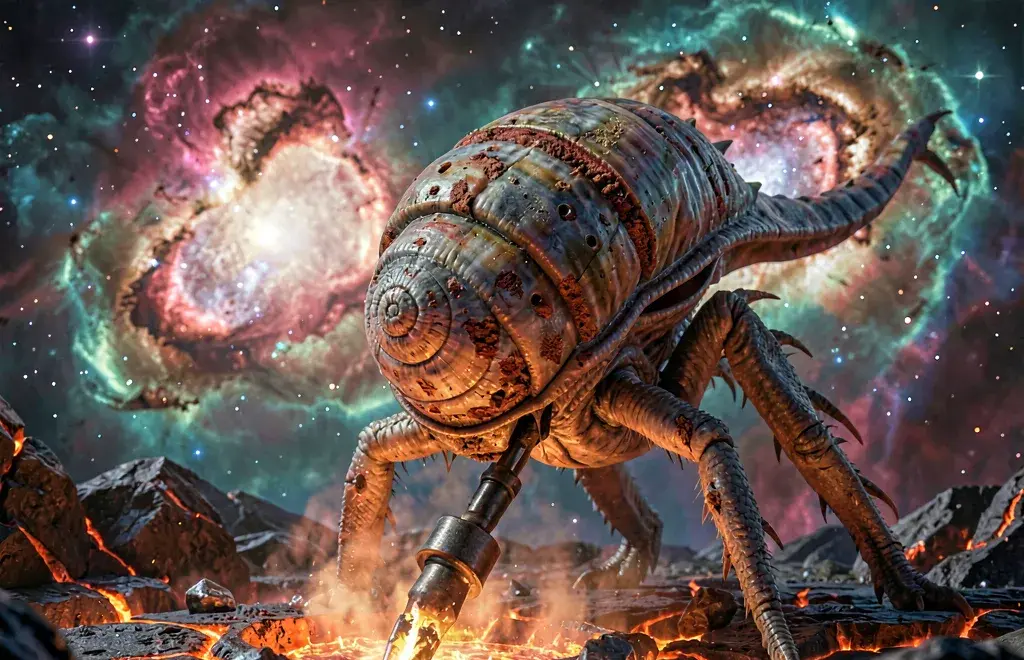
Ferrum-rota tectonicus, or the Crust-Borer, navigates Aethelgard's obsidian plains with a spiral carapace of heat-resistant silicate. Eight hydraulic limbs anchor the creature as its central drill-bit grinds through the cooling lava crust, accessing trapped pockets of volatile gases and rare minerals beneath the planet's shifting tectonic plates. This burrowing scavenger acts as a vital planetary aerator, churning subsurface regolith to release inert gases back into the dense HII atmosphere. By recycling superheated crustal material, it stabilizes local thermal gradients, turning volcanic death zones into nutrient-rich foundations for the nebula's sparse microbial mats.
World Data
- star
- Red Dwarf (M4V), low luminosity, high infrared output
- gravity
- 1.4g
- atmosphere
- Dense CO2/N2 with suspended silicate aerosols; high opacity; no UV, deep violet-blue nebular fluorescence
- temp
- Surface: 450K (217°C) at lava interfaces; Ambient: 380K (107°C); Pressure: 12 atm