
Terra Gravitas
Super-Earth with Hyper-Dense Nitrogen-Argon Atmosphere
Life on Terra Gravitas · 4 species

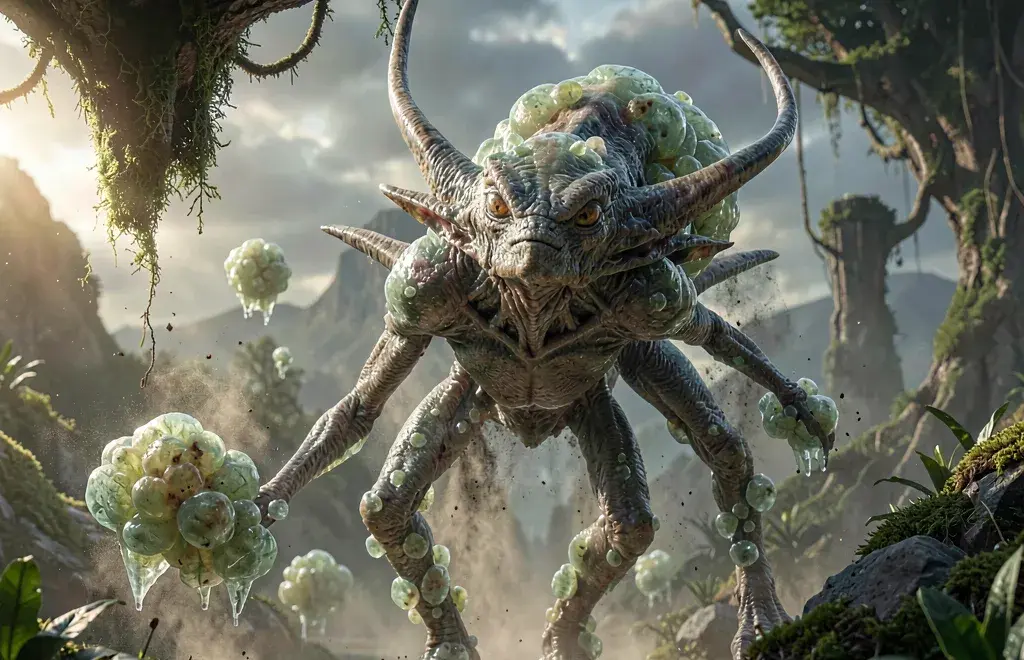
Aerophyta gelatinosa forms vast, translucent ribbons drifting through Terra Gravitas's turbulent lower shear zones. These gelatinous colonies exploit the hyper-dense nitrogen-argon atmosphere for neutral buoyancy, stretching their porous membranes to filter microscopic organic dust from the perpetual haze. Their semi-solid bodies pulse rhythmically, drawing nutrients into a central digestive vacuole while remaining anchored by flexible, root-like tendrils that snag floating debris. Vulnerable to high-altitude scavengers, Drift-Moss colonies often cluster in dense mats near thermal updrafts for protection. They glow with a faint bioluminescent blue when stressed, serving as both warning signal and attractant for symbiotic cleaning fauna. Despite their fragility, they are the planet's primary producers, converting atmospheric particulates into biomass that sustains the entire sub-stratospheric food web below the cloud layer.
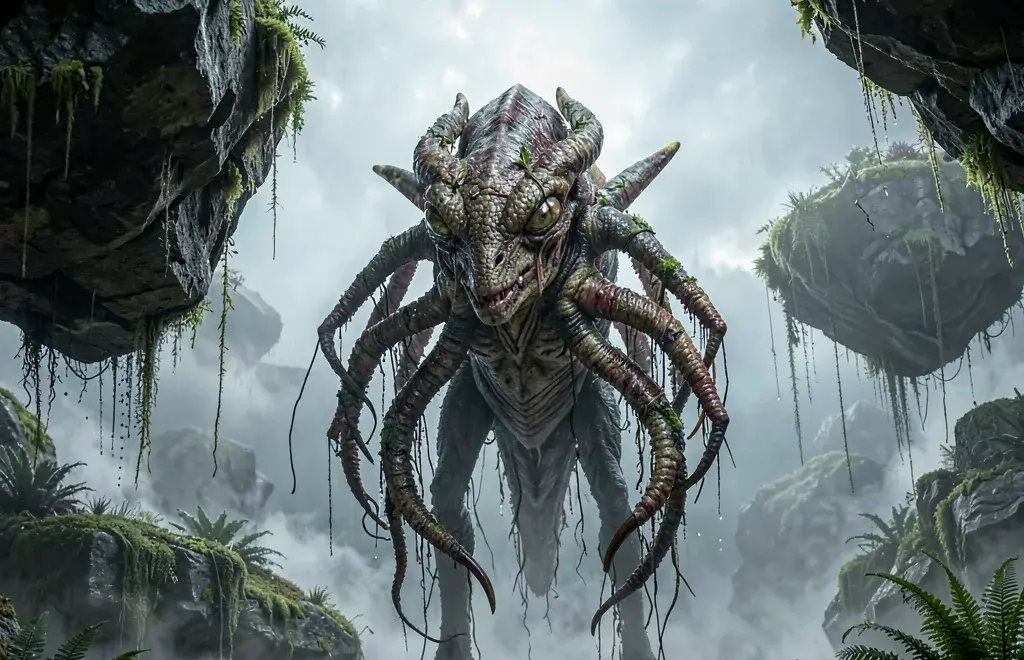
The Crash-Strider (Basis claudens) anchors itself permanently to the scarce basaltic outcrops drifting in Terra Gravitas's hyper-dense nitrogen-argon mist. Its massive, calcified base fuses directly with the rock, resisting the planet's crushing gravity and turbulent atmospheric shear. This sessile filter-feeder extends a labyrinthine network of porous, leathery tendrils into the choking fog to trap microscopic organic detritus suspended within the heavy air currents. Feeding on this nutrient-rich haze, the organism metabolizes slowly, its internal fluids maintaining immense hydrostatic pressure to prevent collapse. During rare atmospheric storms, the Strider retracts its fronds completely, sealing against the substrate until winds subside. Though immobile, it acts as a crucial ecological keystone, converting chaotic floating debris into stable biomass for mobile scavengers that occasionally graze its exposed ridges.
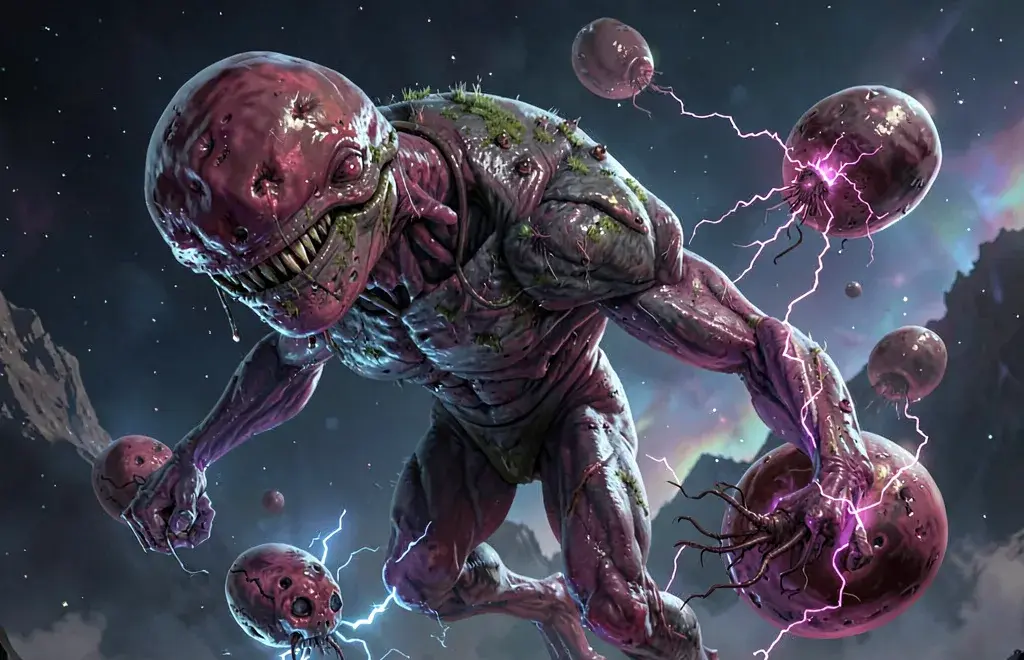
Vena pulsus appears as a translucent, amorphous gel drifting through Terra Gravitas's hyper-dense nitrogen-argon atmosphere. Buoyant yet heavy, these mid-level predators rely on subtle electrostatic fields generated by internal organelles to stun unsuspecting prey within their immediate vicinity. The creature's semi-fluid form allows it to squeeze through high-pressure rock fissures where larger fauna cannot tread, conserving energy in the crushing gravity of this super-Earth. Once contact is made, Vena pulsus delivers a rapid, localized shock that paralyzes small vertebrates or silicate-based lifeforms. The predator then envelops its victim, secreting acidic enzymes to liquefy tissues before absorbing nutrients directly through its porous membrane. This efficient, low-energy hunting strategy sustains the species in an environment where active pursuit would be prohibitively costly due to atmospheric density and gravitational pull.
World Data
- star
- K-type Orange Dwarf
- gravity
- 2.8g
- atmosphere
- 90% Nitrogen, 8% Argon, 2% Methane (Supercritical Fluid Dynamics)
- temp
- -40°C to -10°C (Surface to Stratosphere)