
Thalassa
Subsurface-ocean ice moon
No sun reaches Thalassa's ocean — its sky is the underside of ten kilometres of ice, its warmth the slow flex of tides and the fire of seafloor vents. Energy rises from below as chemosynthetic snow, and life hangs from the frozen ceiling in glowing constellations. The Lanternveil fishes this eternal dark with its own light, in a sea that has never known a dawn.
Life on Thalassa · 4 species

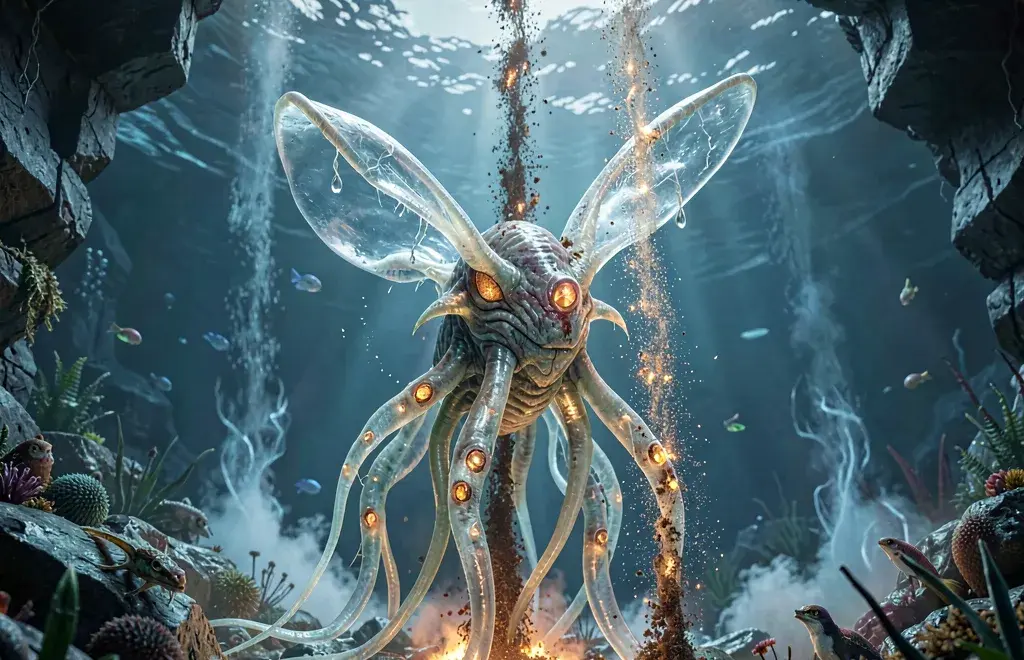
The Thermal Mat-Weaver (*Chemosynthesia filamentum*) anchors as translucent ribbons to Thalassa's hydrothermal vents, where specialized internal receptors oxidize sulfide plumes into vital organic biomass. These delicate, ribbon-like primary producers form the solitary foundation of the subsurface benthic food web, thriving in absolute darkness by converting geochemical energy directly into living tissue without sunlight. Their rhythmic heat-contraction cycles function as biological pumps, drawing nutrient-rich water upward through their semi-permeable matrices. This continuous motion seeds the dark water column with microscopic detritus, sustaining diverse suspension feeders and driving the moon's entire ecosystem from the vent floor to the ice ceiling above.
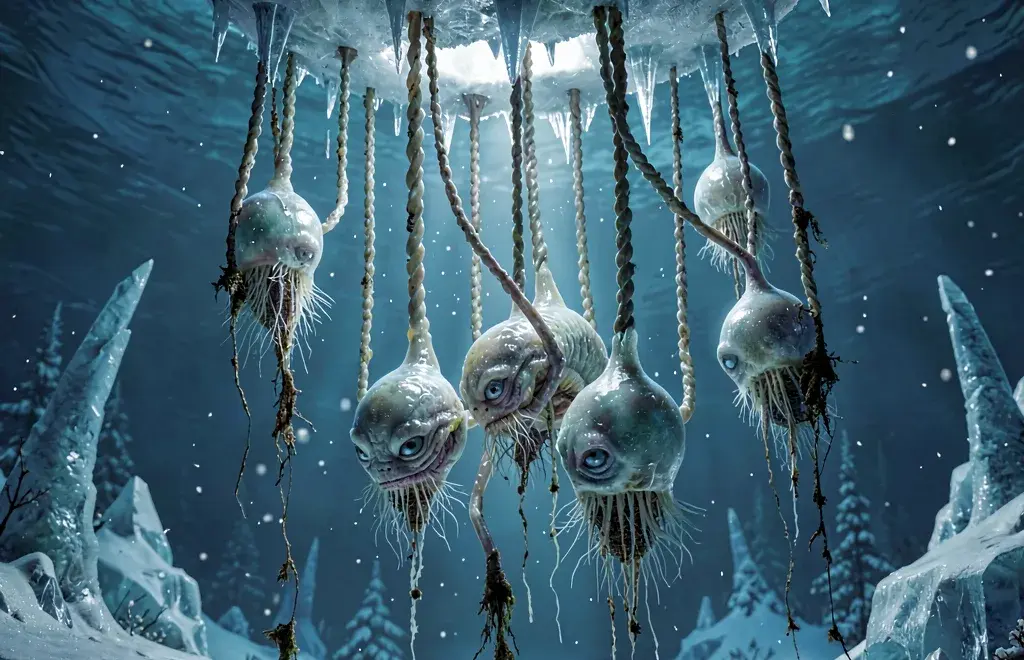
Glaciflux appendiculatus, or Ice-Hanger Grazers, dangle in serpentine chains from Thalassa's ice shell, their gelatinous bodies suspended in the moon's gentle 0.14g gravity. These filter-feeders possess low-mass, hydrostatic skeletons that require no active swimming; instead, they drift passively within the subsurface currents. Each segment features a ciliated bell structure designed to sieve chemosynthetic particles and decaying Lanternveil tissue from the dark water column above. Functioning as vital detritivores, these grazers process organic snow falling through the ice cracks, recycling nutrients back into the ecosystem without expending significant energy. Their translucent forms shimmer faintly against the gloom, creating a living curtain of regeneration. By harvesting drifting biomass efficiently, they sustain the moon's fragile food web while remaining perfectly adapted to the silent, frigid depths of their frozen world.
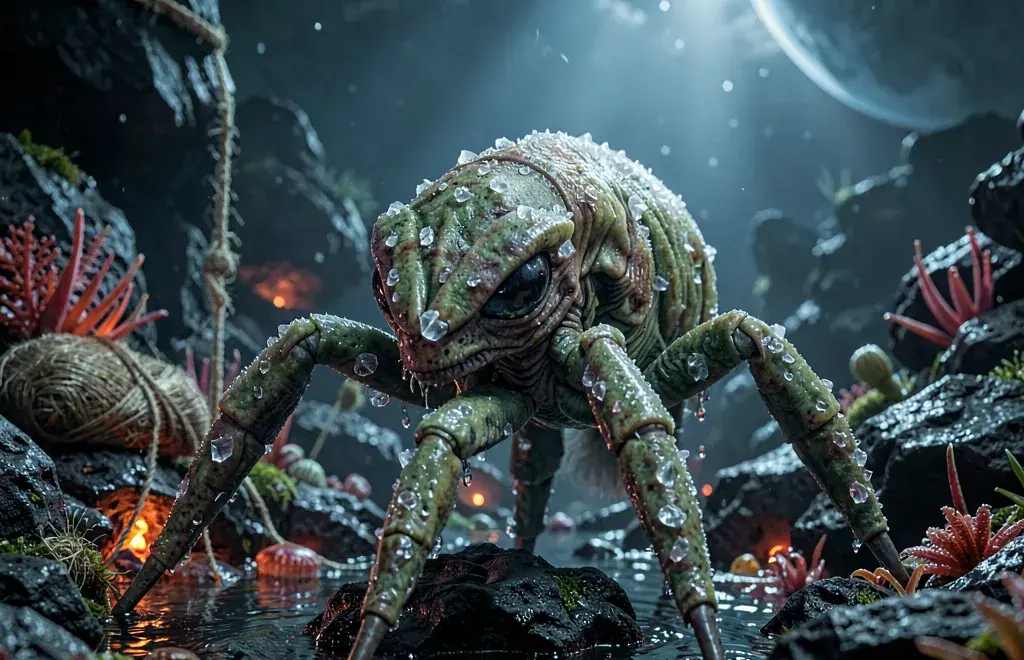
The Vent-Shadow Striker (Thermovora silens) remains nearly invisible against black basalt near Thalassa's hydrothermal vents, its hexapedal form blending seamlessly with the obsidian seafloor. This ambush predator detects minute thermal gradients and pressure shifts to stalk mat-weavers and small grazers before striking with lethal precision from the darkness. Its segmented body is reinforced with dense silica deposits, creating armor capable of crushing crustacean shells while negating buoyancy costs in high-pressure currents. As a keystone species, T. silens regulates benthic invertebrate populations, ensuring ecosystem stability within the moon's subsurface ocean without expending energy on vertical navigation.
World Data
- Star
- none — tidal heat
- Gravity
- 0.14 g
- Medium
- liquid water, total dark
- Shell
- 10 km of ice