
Brachys
Super-Earth
Almost three gravities rewrite every body that grows large: tall is fatal, falls shatter bone, standing up is a constant expense. But the dense, oxygen-rich air pays for a fierce metabolism. The result is a world of low, wide, armoured life that never leaves the ground — the Anvilback chief among them, built like a foundation slab that learned to graze.
Life on Brachys · 4 species

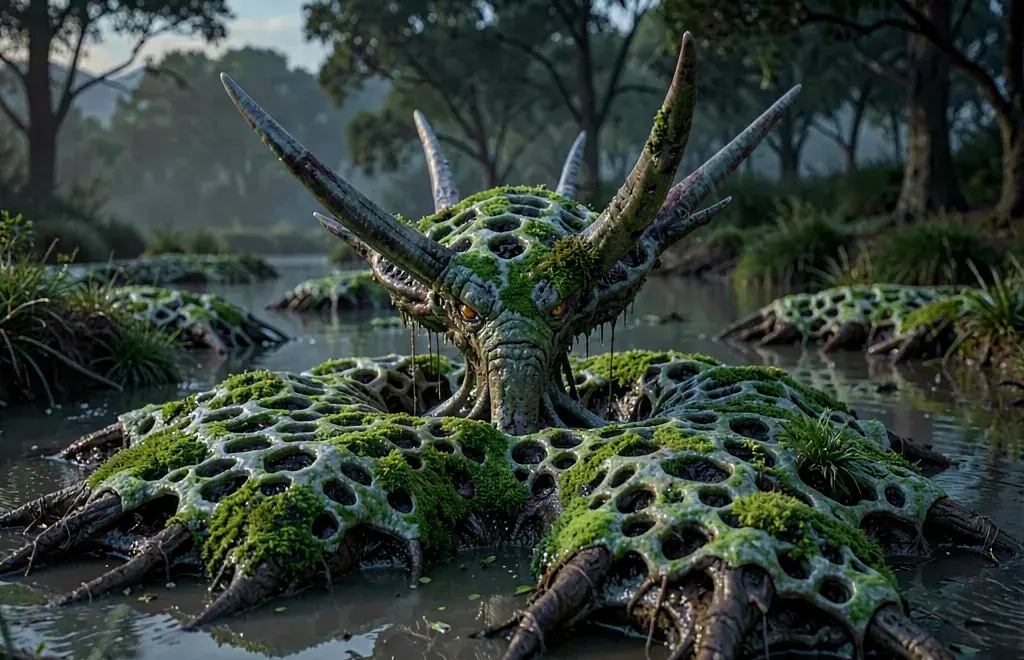
Planofolium straticus, or Moss-Slab, dominates Brachys's flood plains as a dense, silicate-reinforced crust. Adapting to 2.9g gravity and dim K-type illumination, its thick, photosynthetic lattice spreads horizontally rather than vertically. This low-profile architecture maximizes light capture while resisting crushing pressure, forming an unbroken carpet of carbon-sequestering flora across the stagnant waters. Reproduction occurs entirely subterranean; root-like anchors draw dissolved nutrients without ever elevating structures above ground level. The species functions as a massive primary producer and ground-cover sink, locking away atmospheric carbon within its rigid cells. Observers note that disturbing these slabs releases trapped gases, confirming their role as both the planet's foundation and its respiratory buffer.
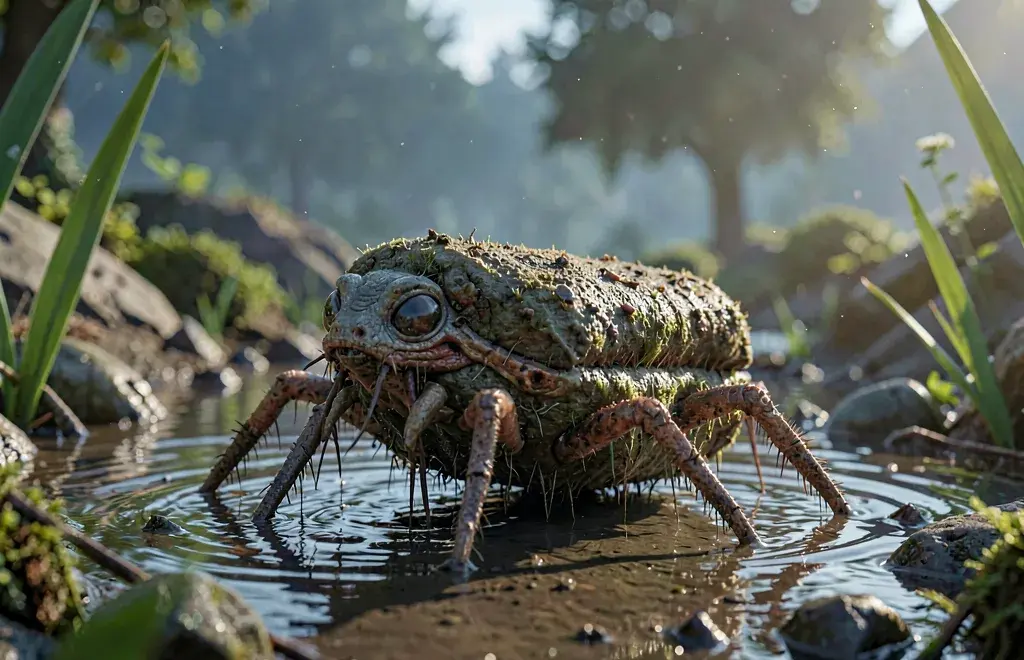
The Silt-Drone (*Filtera plana*) skims Brachys's dense, oxygen-rich surface waters as a flattened, multi-legged box stabilized by low-profile cilia. This geometric form prevents toppling in the planet's crushing gravity while allowing efficient grazing on microbial silt mats inches above the mud. Its body acts as a living sieve, trapping detritus without the instability of an upright posture. Driven by a hyper-efficient anaerobic metabolism triggered by the thick atmosphere, these grazers process vast quantities of organic matter with minimal energy expenditure. They move in silent, rhythmic pulses, converting the planet's nutrient-rich silt into biomass while maintaining a precarious hover just above the treacherous substrate, perfectly adapted to Brachys's unique hydro-thermal dynamics.
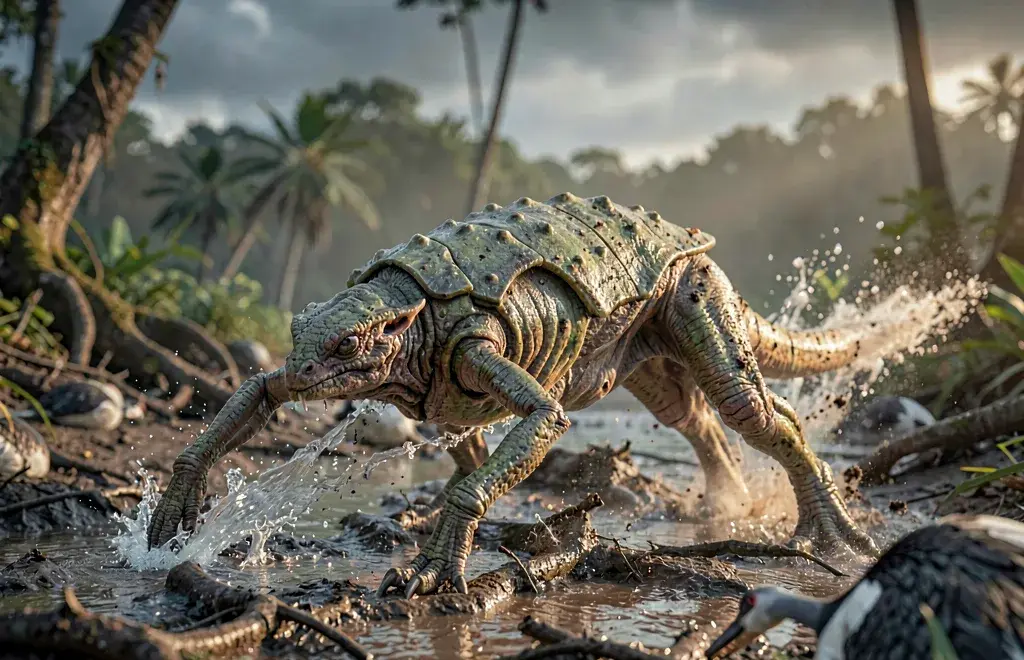
Fractura humilis, colloquially the Crack-Striker, is a low-slung, heavily armored ambush predator endemic to Brachys's silty basins. Evolving under crushing gravity, it remains motionless in the mud for days, sensing substrate vibrations from slow-moving Anvilbacks. When prey rests nearby, the creature unleashes a sudden lateral jet of pressurized water, destabilizing its target before delivering a terminal blow with its reinforced carapace. Incapable of sustained pursuit due to physiological limits on this super-Earth, F. humilis acts as an opportunistic scavenger and weakener. It targets only the injured or aging Anvilbacks, relying entirely on seismic sensitivity rather than speed. This specialized hunting strategy allows it to thrive within dense mudflats where larger predators cannot maneuver effectively, turning the heavy ground into its primary weapon.
World Data
- Star
- K-type orange
- Gravity
- 2.9 g
- Atmosphere
- thick, O₂-rich
- Terrain
- flood plains