
Xylos-9
Thin-Vacuum High-Altitude Exoplanet
Life on Xylos-9 · 4 species

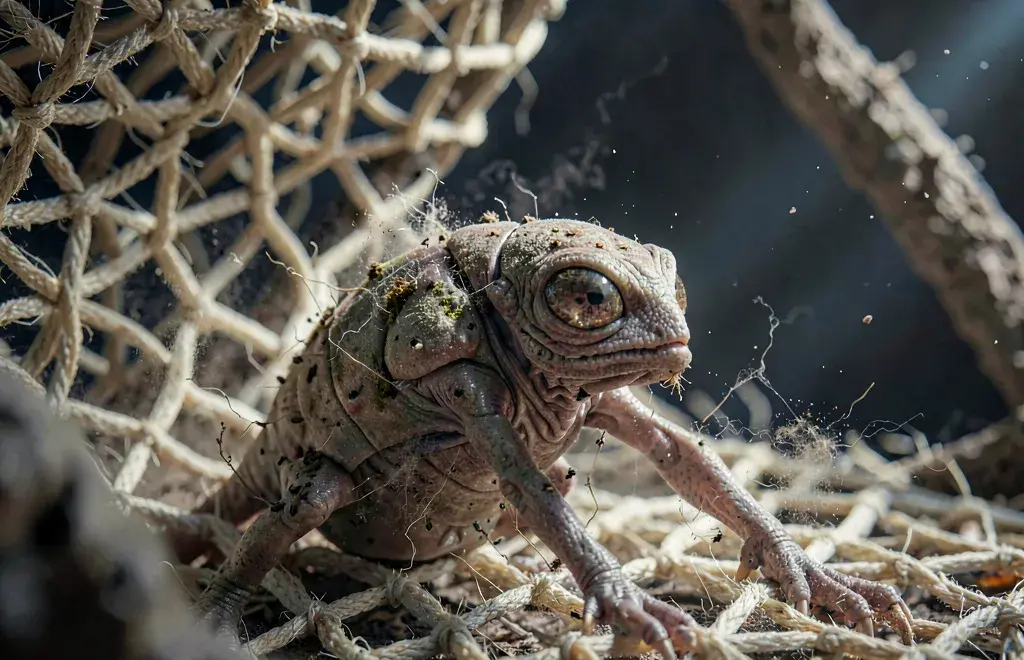
The Dust-Mite (*Litho-granum*) is a microscopic grazer endemic to Xylos-9's thin-vacuum stratosphere. Encased in a refractive silica-carapace, these organisms drift within high-altitude dust clouds, filtering particulate silicates for sustenance. Their hexagonal exoskeletons reflect the pale solar radiation, rendering them nearly invisible against the amber haze until they cluster. Individuals frequently anchor themselves to the Thermal-Weave's lattice, a synthetic structure stabilizing local atmospheric temperature. Here, they form dense, living carpets that harvest residual heat while grazing on suspended grit. This symbiotic adherence prevents their dispersal into the lethal upper vacuum, creating a fragile biofilm essential to the station's thermal regulation and dust filtration systems.

Thermovora parasitus manifests as a translucent, vein-like film on the underside of Xylos-9's Thermal-Weave organisms. This epibiotic bacterium infiltrates the host's micro-capillaries to siphon thermal gradients essential for cellular metabolism. In the thin vacuum of high-altitude zones, where ambient heat is scarce, the parasite creates localized cold spots, causing immediate tissue necrosis in its host while sustaining its own rapid replication cycle through stolen energy fluxes. Infested specimens exhibit a distinct frost-bloom pattern along their dorsal ridges as internal temperatures plummet. Without intervention, the Thermal-Weave's metabolic processes freeze within hours, leading to structural collapse of the host's protein lattice. Field researchers recommend immediate cryo-scraping of infestation sites, though removal often proves fatal due to the irreversible thermal shock inflicted during the parasite's initial energy theft.
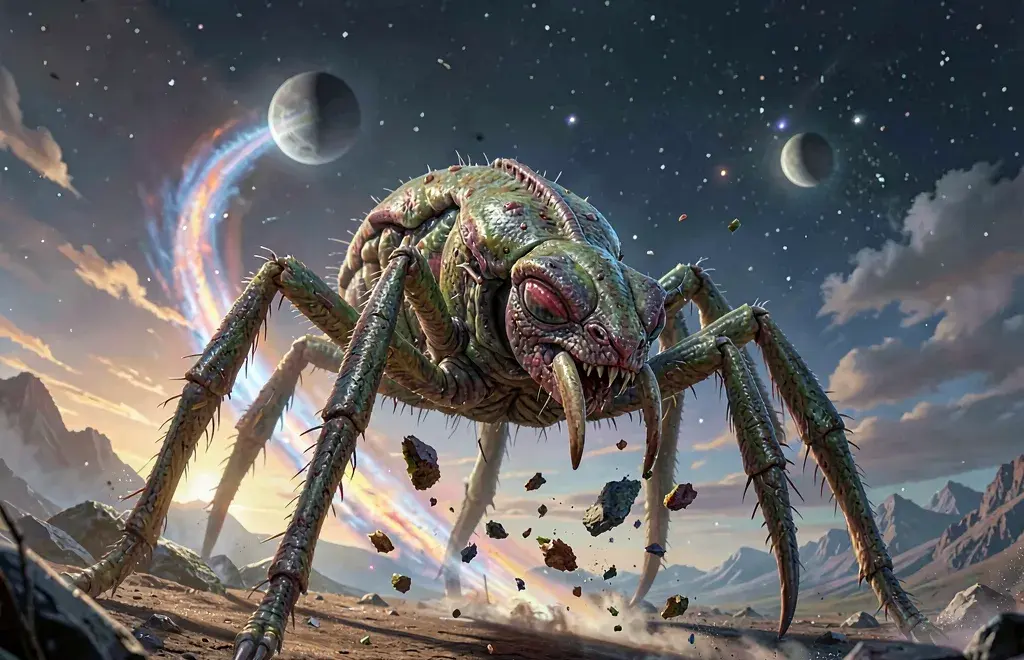
The Surface-Crawler, or Terra-stalker, thrives in Xylos-9's thin upper atmosphere, utilizing six elongated, multi-jointed legs to traverse rocky regolith with minimal contact. Its carapace reflects ultraviolet radiation for thermal regulation, while specialized sensors detect minute heat signatures of drifting Thermal-Weave fragments. In low gravity, the creature moves with fluid precision, conserving energy between brief, explosive bursts of movement needed to navigate the planet's jagged highlands. Occasionally, these arachnids launch themselves into the jet stream, using aerodynamic body flattening to glide toward floating organic debris. With a sudden leap, they snatch smaller Thermal-Weave fragments from the air currents before gravity reclaims them. This unique aerial foraging strategy allows survival where ground resources are sparse, turning turbulent wind layers into a dynamic hunting ground for this agile, high-altitude predator.
World Data
- star
- K-type Orange Dwarf (low UV, high IR)
- gravity
- 0.35g
- atmosphere
- Extremely tenuous CO2/Nitrogen mix; surface pressure 0.08 atm
- temp
- -140C to -60C (diurnal cycle driven by stellar flux)